by Library Docent Volunteer Andy Ludlum
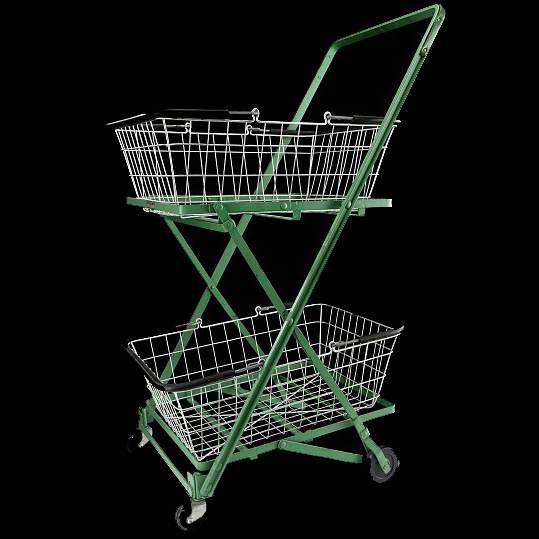
One evening in 1937, grocer Sylvan Goldman noticed a problem. Shoppers, often women with children, struggled to carry heavy baskets under their arms. Once the baskets got too full, they stopped buying. Looking around his office, Goldman spotted a folding chair and had an idea. With help from an employee, he built a prototype: a folding frame on wheels with two baskets stacked where the seat would be. It was the first shopping cart.
While the cart didn’t catch on right away, it soon became a symbol of modern convenience and spread across the country. After World War II, carts helped attract customers to larger supermarkets, including those in Ventura County.
Although he built his business in Oklahoma City, Goldman’s inspiration began in California. In the early 1920s, he and his brother worked for grocery wholesalers in Southern California, where Ventura County was part of a rapidly developing regional food distribution network. Wholesale produce was provided for a revolutionary store concept that brought meat, produce, and canned goods together under one roof.
The Era of Specialization
At the turn of the 20th century, Ventura shoppers rarely went to a single market. Instead, they visited family-run businesses along Main Street; a butcher for meat, a bakery for bread, and a general store for dry goods.
Perhaps one exception was the Ventura County Co-operative Association. Founded around 1888, it functioned as a community-owned department store, where local farmers and residents could buy goods at lower prices and share in the profits. At its core, it was a large general store. From its Main Street location between Palm and Chestnut Street, it sold a wide range of everyday needs, including groceries, dry goods, clothing, hardware, tools, and agricultural supplies. The store was the largest and most complete mercantile business in Ventura County. As it grew, the association expanded beyond Ventura, opening branch stores in other communities, including Piru.
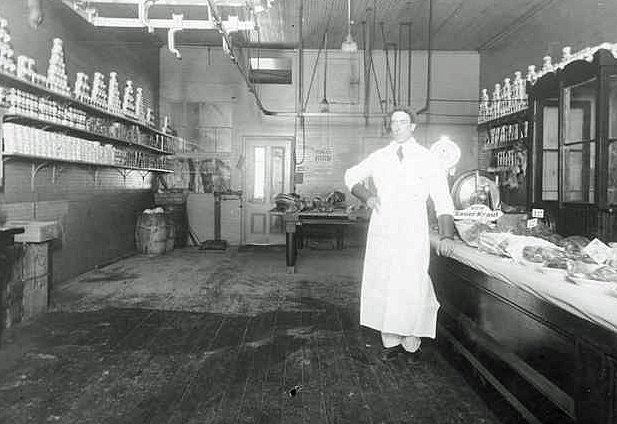
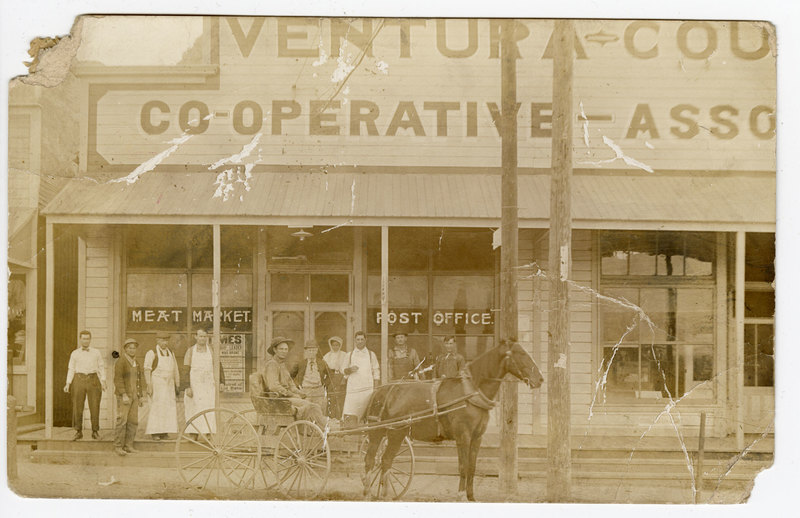
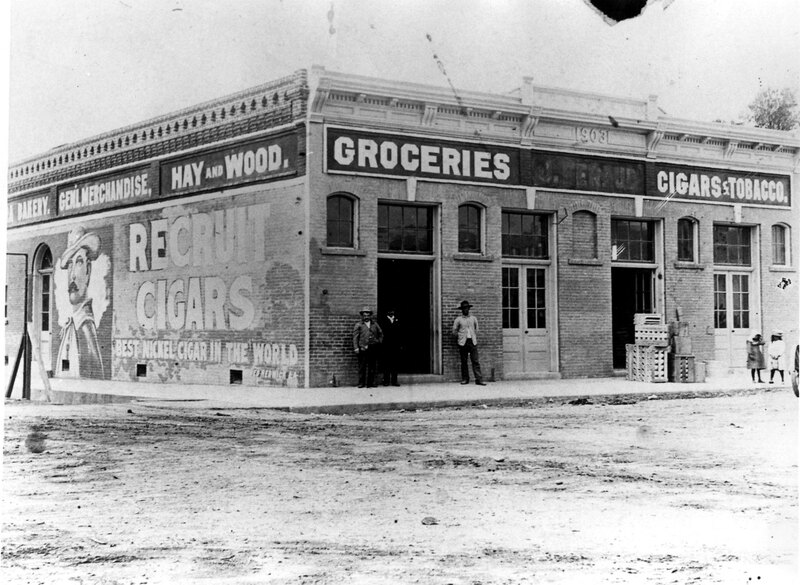
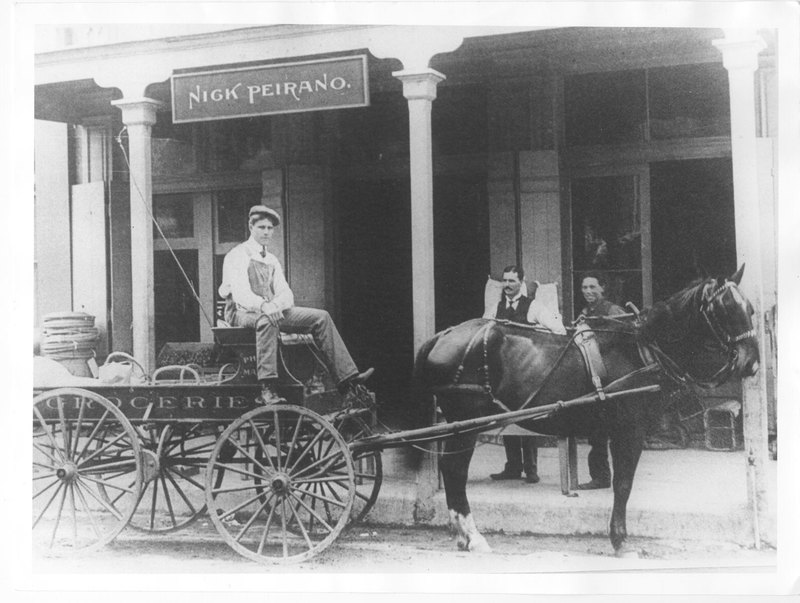
Early Ventura stores like Peirano’s Market and the Feraud General Merchandise Store were not self-service, they were full-service counters. Peirano’s, opened in 1877 across from the mission, was filled with the smells of coffee, flour, and pickles stored in open barrels, and sold everything from groceries to tools, wine, and even blasting powder. Feraud’s began in 1890 and grew into a larger brick store by 1903, offering bread, groceries, and animal feed.
Shopping was a daily routine since most homes lacked refrigeration. Instead of picking out items, customers handed a list to a clerk at a long counter. The clerk gathered goods from high shelves and backrooms, weighing bulk items like grain before preparing the order. The experience was highly personal. Storekeepers knew their customers and often extended credit, allowing families to pay later when crops were sold or wages came in. Delivery was also common, with groceries brought to homes and ranches, first by horse-drawn wagons and later by trucks in the 1920s.
Cash and Carry
By around 1910, as Ventura grew and the cost of living rose, “cash and carry” markets began to appear. These low-price stores cut out extras and offered no credit or delivery. Shoppers still ordered from a clerk, but paid cash and carried their groceries home themselves, often in small baskets. For the first time, customers traded convenience for savings, and the slower, social feel of the old general store began to fade. Behind the scenes, the system was changing too. Wholesalers stopped extending credit and shifted to their own cash-and-carry model, lowering prices but pushing costs onto retailers. Store owners now had to transport goods themselves from Los Angeles or Oxnard.
To keep up, many stores dropped credit, paving the way for growing chains, while older businesses like Peirano’s and Feraud’s held out and continued to offer service, credit, and delivery. One of the most successful new chains was Daley’s Cash and Carry, founded by Joe Daley in 1914. Starting as “Rock Bottom Grocery” in Los Angeles, Daley’s cut costs by eliminating services and quickly expanded, reaching nearly 50 stores by 1919 and about 200 by the mid-1920s. The chain entered Ventura County around 1926, opening busy downtown locations in Ventura and Oxnard. With standardized storefronts and bold “Cash and Carry” signs, Daley’s made its message clear: lower prices, but no credit or tabs.
Piggly Wiggly and the Self-Service Revolution
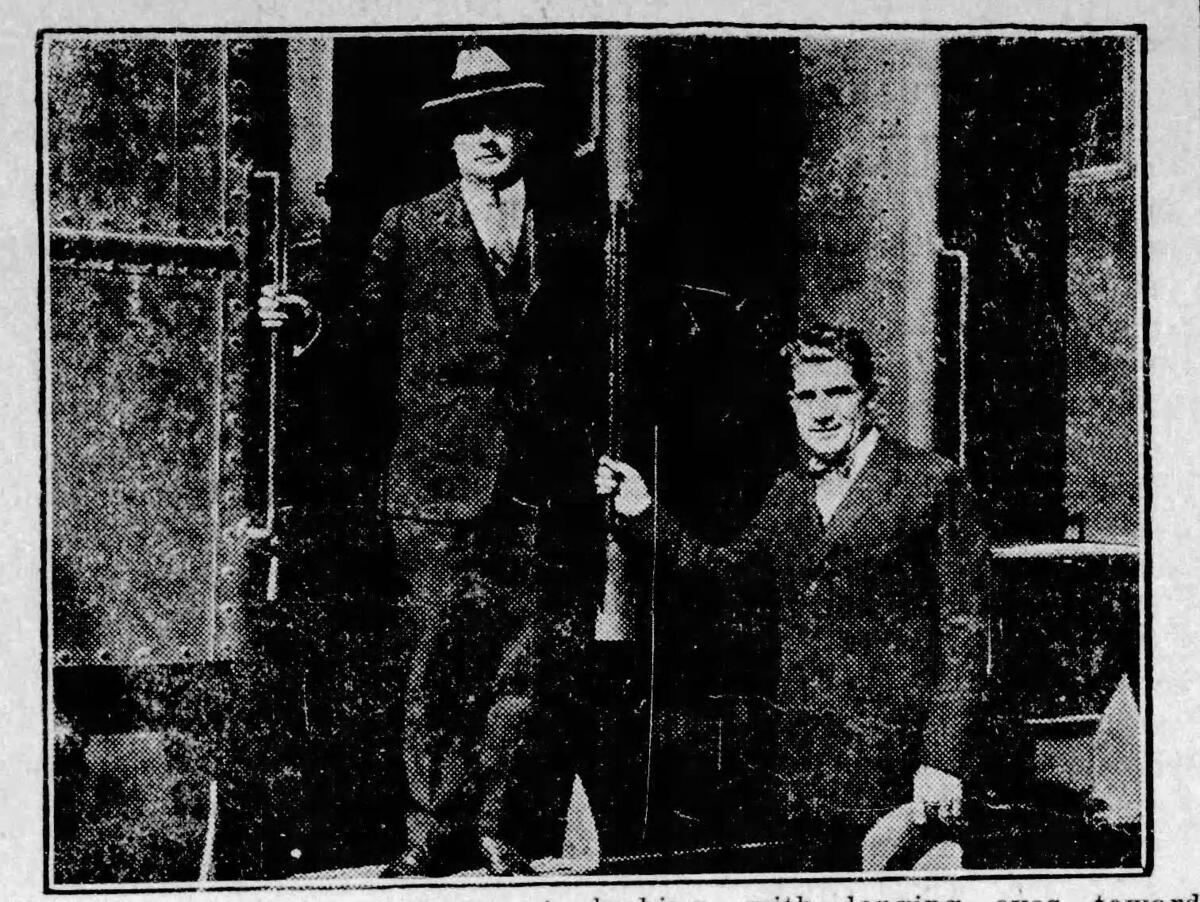
After World War I, Ventura County began to see major changes in how groceries were sold. Cars and expanding electrical service made faster delivery and refrigeration possible, and stores began promoting “modern” methods. Self-service shopping began to emerge, replacing the old counter system. This shift introduced prepackaged, branded goods in place of bulk items and new supply systems, as chains bought directly from manufacturers and used faster distribution. Ventura’s location near rich farmland also helped stores move fresh local produce more efficiently.
By about 1920, the city’s grocery trade had consolidated into a handful of established businesses along Main and California Streets, just as new chain models were beginning to challenge them.
In 1924, Piggly Wiggly, which operated 1,600 stores in 39 states, announced plans to take over the long-running Blackstock grocery. The deal, as described by the Ventura Daily Post, included remodeling the store into a modern self-service market, but it quickly fell apart. Instead, owner James Blackstock chose to stay and modernize on his own. It was only a brief setback. Within weeks, Piggly Wiggly announced a broad Southern California expansion and added 15 stores including one in Ventura.
The Maze That Changed Grocery Shopping
An ad in the Morning Free Press announced the opening of Ventura’s first Piggly Wiggly at 715 Main Street on March 7, 1925, heralding a completely new way to shop. Instead of waiting at a counter, customers could “move freely through the store,” selecting items themselves “without any pressure or persuasion.” The store used a patented, maze-like layout that guided shoppers through each aisle, encouraging them to see and handle every product. The ad stressed independence and convenience, noting that customers could browse or buy at their own pace. It also promised practical benefits: lower prices, a wider selection, and clearly marked price tags. In many older stores, prices weren’t posted and could vary depending on the clerk or whether a customer bought on credit.
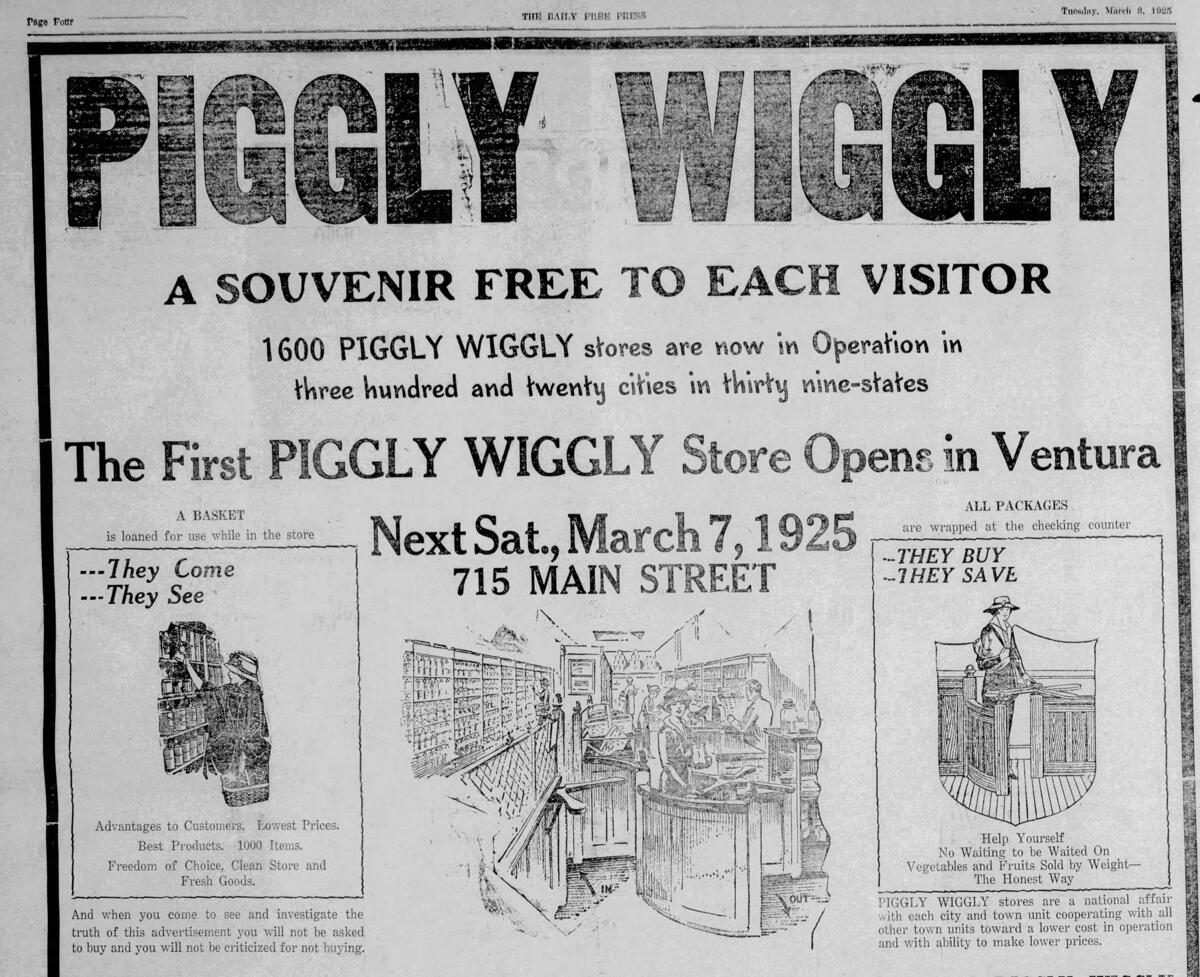
Just as important was the store’s modern feel. Described as “clean, orderly, and modern,” it replaced open barrels with packaged goods, bright lighting, and polished surfaces. The message went beyond groceries. It presented self-service shopping as a “steppingstone to better living at less cost,” and positioned Piggly Wiggly as part of a new, more efficient and sanitary way of life.
The Morning Free Press reported that shoppers at the Piggly Wiggly opening would “secure a basket in which to place their selections” and choose from more than 1,000 items, with “price tags swinging before the various products,” along with fresh fruits and vegetables.
But the basket revealed a clear limit of early self-service: customers could only carry so much and loads often grew heavy before they reached the checkout. The store quickly adapted, promising that if a basket filled up too soon, a clerk would carry the parcels out to the customer’s car.
In the Ventura Weekly Post and Democrat, Piggly Wiggly manager W. O. Hedley explained the store’s new approach to shopping. He argued that customers who ordered groceries by phone were missing out, saying, “If you… order your groceries… over the telephone, you have no one but yourself to blame if you do not receive the pick of the market.” Instead, he encouraged shoppers to come in and select items themselves, much like choosing clothing. Hedley declared that “the day of the grocery cracker barrel is gone,” replacing it with “standardized self-service high-grade grocery stores” where “there are no salesmen… The goods themselves are the only salesmen.” Customers could select exactly what they wanted, “just the size you wish… as many as you wish.” Hedley said lower prices came from cutting services like delivery, which required competitors to “charge slightly higher prices.”
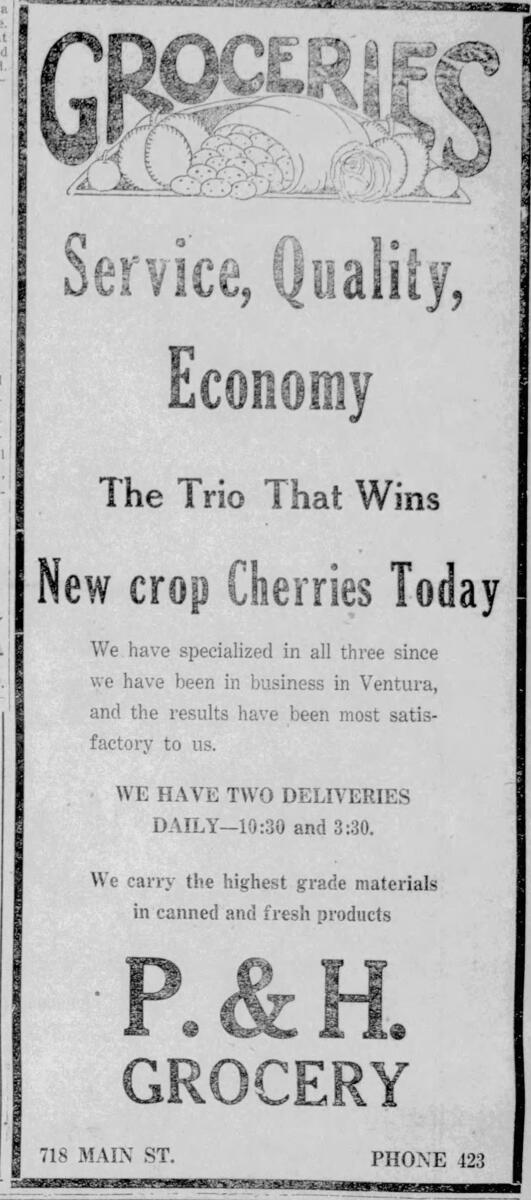
Three months after opening, Ventura’s Piggly Wiggly added a meat market, bringing more of the shopping experience under one roof. It was run by George Porter, a butcher with 13 years of experience at Hobson Brothers Packing Company. The Ventura Weekly Post and Democrat welcomed the addition, noting Porter had “a great many friends in this district who will be pleased to know that he has entered business for himself.”
Clarence Saunders opened the first Piggly Wiggly in Memphis in 1916. His new approach was a huge success and it caught the attention of Wall Street; in the early 1920s, investors began betting that his company would fail. Saunders tried to fight back by borrowing millions to buy up his own stock and drive the price higher, hoping to squeeze out the speculators. For a short time, it worked and the stock price jumped to $124 a share. But the New York Stock Exchange stepped in and paused trading, giving investors time to recover. Saunders lost his edge, couldn’t repay his loans, and eventually lost control of his company. Ventura’s Morning Free Press reported in August 1923 a block of 1,500 Piggly Wiggly shares sold at auction for $1 a share.
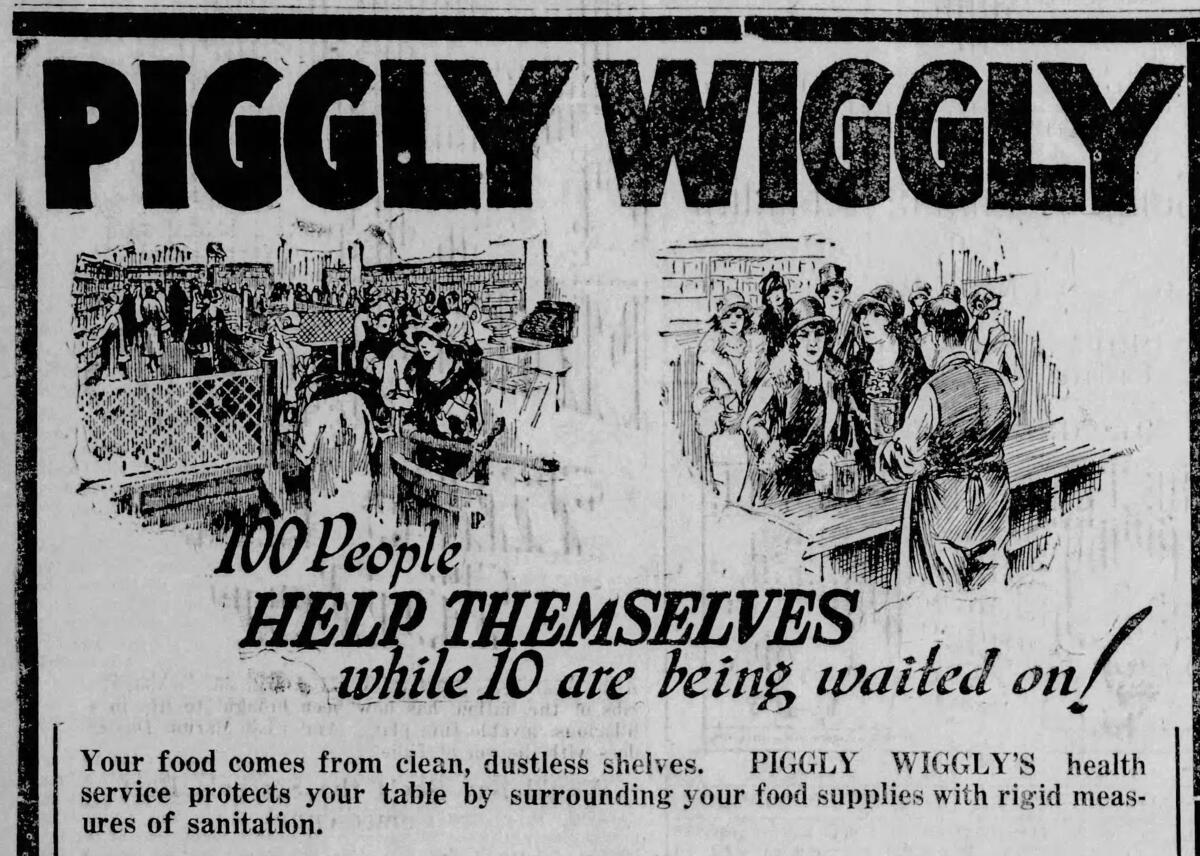
The Free Press explained that the Piggly Wiggly system consisted of locally owned and operated stores, supported by regional home offices in New York, Chicago, and Los Angeles. These offices purchased directly from manufacturers, giving local operators “the best prices” and keeping them “advised as to new and successful merchandising and advertising ideas.” In early 1926, Hedley filed incorporation papers for a company to operate Piggly Wiggly stores in Ventura County. Incorporated for 50 years, the firm held the right to open new stores in any town in the county. Two years later, local customers were invited to invest in the company itself, not just shop there, opening what had been a closed corporation to public ownership and helping finance rapid expansion.
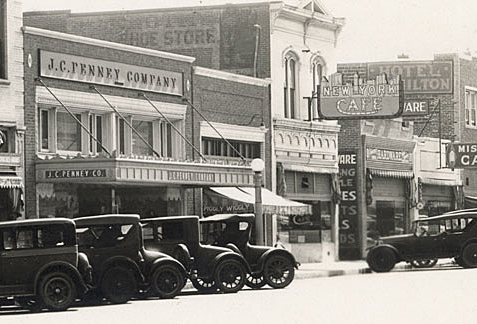
By the end of that year, new stores opened at 122 Ventura Avenue in Ventura and at 958 Main Street in Santa Paula. Newspaper advertising soon promoted “Piggly Wiggly, a Ventura County institution.” One ad in the Ventura Weekly Post and Democrat emphasized its local identity, asking, “Do you know that Piggly Wiggly Ventura County is a purely home institution – owned and operated by Ventura County people – not affiliated with any other chain store organization? Trade with home folks.” This strong hometown branding reflected growing pressure from expanding West Coast chain competitors.
Safeway Moves into the County
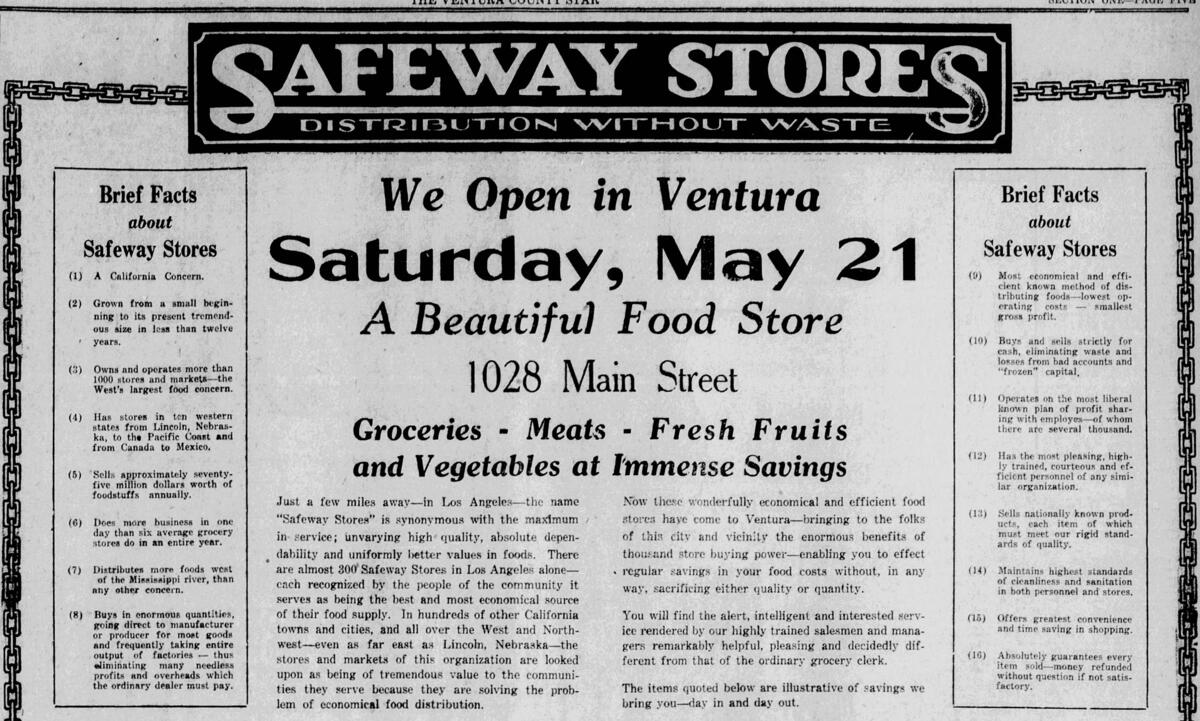
In spring 1927, newspapers across Ventura County reported the arrival of Safeway, signaling a major change in the local grocery market. In April, the Morning Free Press announced that Safeway had secured its first Ventura location, describing the company as “the largest food distributing organization west of the Mississippi River,” with thousands of stores already operating, including hundreds in California. The paper added that Ventura was only the beginning, as Safeway planned multiple stores across the county as part of a new regional district.
Ten days later, the Oxnard Press-Courier confirmed the rapid expansion. Safeway had signed a long-term lease for a major site on Fifth Street in Oxnard and was planning additional stores in Ventura, Santa Paula, and Fillmore. District manager W. M. Bush again emphasized the company’s scale as “the largest chain store system west of the Mississippi,” while also highlighting goals such as training local employees and buying from regional farmers. On May 20, the Free Press announced: “Safeway Stores to Open Tomorrow.” Ventura’s first store, at 1028 Main Street, officially brought the city “into the chain of distributors of foodstuffs.” Local manager Ed Hipple expressed confidence in the region’s growth and confirmed that more stores were soon to follow.
As Safeway opened its Ventura store, its advertising focused heavily on its size and buying power. The company claimed that with more than 1,000 stores, it could “buy in enormous quantities…frequently taking the entire output of factories,” cutting out middlemen and passing along “immense savings.” For competitors like Piggly Wiggly, which relied on standard wholesale supply channels, this pointed to a rival capable of consistently undercutting prices. Safeway also promoted “distribution without waste,” “lowest operating costs,” and a strict cash-only system designed to eliminate losses from credit. Although Piggly Wiggly had pioneered the self-service grocery model, Safeway argued it had taken the concept further by stripping out every possible expense to drive prices down. The message was clear: Safeway was not just another grocery store, but a large-scale, highly efficient, cash-based chain that could sell the same goods for less—something even innovative local operators like Piggly Wiggly struggled to match.
As stores offered more goods, shoppers were encouraged to stock up on everyday items. In a 1928 column in the Morning Free Press, writer Cherie Brittell promoted keeping a “Piggly Wiggly shelf” at home—an early pantry stocked with staples bought in quantity so one was “never embarrassed by the arrival of unexpected company.”
Depression-Era Pressure on Local Grocers
Small, locally owned stores still dominated the landscape in Ventura in 1930, often combining groceries with other goods like feed, baked items, and household supplies. Even early chain stores like Piggly Wiggly operated on a neighborhood scale, with compact layouts and limited inventory. Most customers walked to shop, so stores were tightly clustered in downtown areas, creating a dense network of small, service-oriented markets. The Great Depression disrupted the grocery industry. As shoppers reduced spending, weaker stores were forced to close. At the same time, large chains expanded aggressively. Safeway grew rapidly by acquiring competitors and building a more centralized system. This combination of economic hardship and corporate expansion meant that Ventura’s grocery market began to shift away from independent stores toward fewer, more powerful chain operators.
As these changes took hold, local grocers like Daley’s and Piggly Wiggly came under increasing pressure. Large chains could use bulk purchasing to offer lower prices, while customers began expecting greater variety and convenience. Across California, many Piggly Wiggly stores were sold, rebranded, or replaced. By about 1935, the Piggly Wiggly name had largely disappeared from the state. The final reference in the Ventura Weekly Post and Democrat came in 1944, when it reported that the new Santa Cruz Market was opening in the remodeled 1924 E. Main Street building, “formerly occupied by Piggly Wiggly.”
Piggly Wiggly did not so much “fail” in Ventura as it succeeded in changing the industry. Its self-service model was widely copied and ultimately absorbed by larger competitors. Its lasting impact was not the individual stores, but the system that remains the foundation of modern supermarkets. In just three decades, small specialty grocery shops gave way to self-service stores driven by rapidly expanding chains. By the late 1930s, these chains were opening high-volume, low-cost markets that emphasized size, parking, and efficiency.
Baskets and Rolling Carts
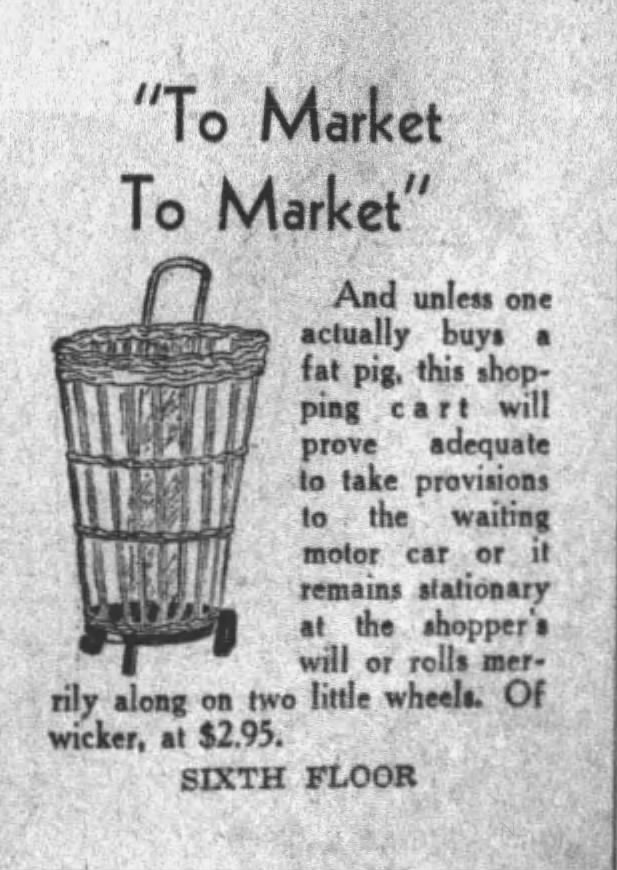
Even as stores encouraged shoppers to buy more, customers were still limited by what they could physically carry. Many people walked to downtown grocery stores and needed a way to transport heavy bags home. In the 1930s, hardware stores began selling wicker baskets on wheels, marketed as carts that could carry provisions to a car and “roll merrily along on two wheels.”
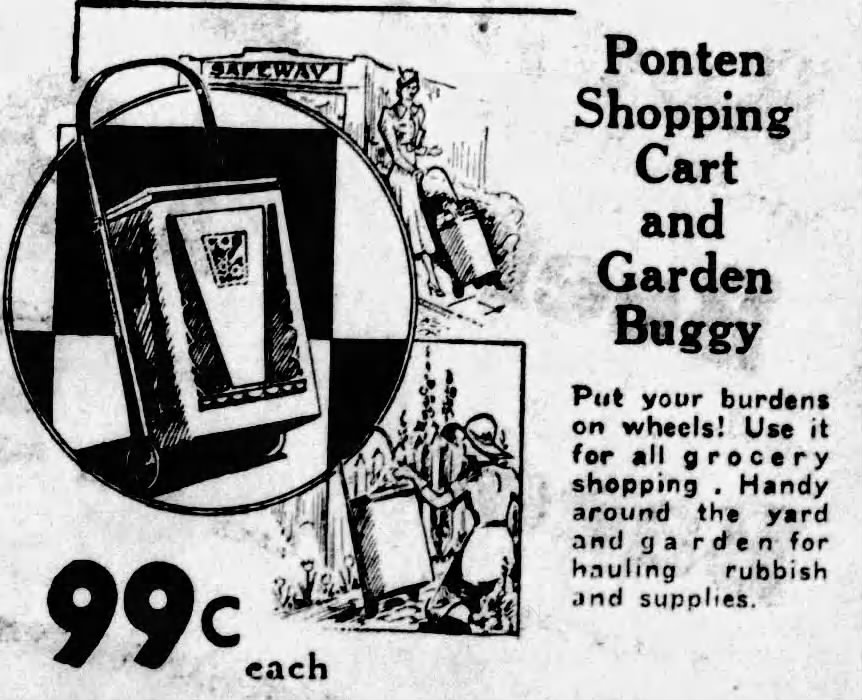
The “Handy Ann” shopping cart was a small, rubber-wheeled cart introduced to shoppers in the 1930s designed to hold “burdensome shopping bags” and purchases, allowing customers to move easily around a market without the strain of carrying heavy items. By 1937, Safeway stores in California introduced the Ponten Shopping Cart and Buggy, a sturdier design with larger wheels and a reinforced frame. Manufactured by a Berkeley company, it promised to “put your burdens on wheels,” and could also be used at home as a yard or garden cart.
Sylvan Goldman’s Self-Service Icon
Goldman’s 1937 shopping cart prototype didn’t look like one of most influential innovations in 20th-century retail culture. It was literally a wooden folding chair with wheels on the legs and a basket on the seat. Goldman believed his “Folding Basket Carriage” would benefit everyone. It would make shopping easier for customers and help stores sell more, since people could buy more than they could carry by hand.
When Goldman visited one of his Oklahoma City stores later that day, he was disappointed. “I went down there with great expectations. When I got there, there wasn’t a damned soul using a shopping cart.” He asked the customers why. Many men thought the carts looked unmanly, while some women said they resembled baby carriages. “I’ve pushed my last baby buggy forever, I hope,” one woman told him. Another shopper protested, “Don’t you think this arm is strong enough to carry a shopping basket?”
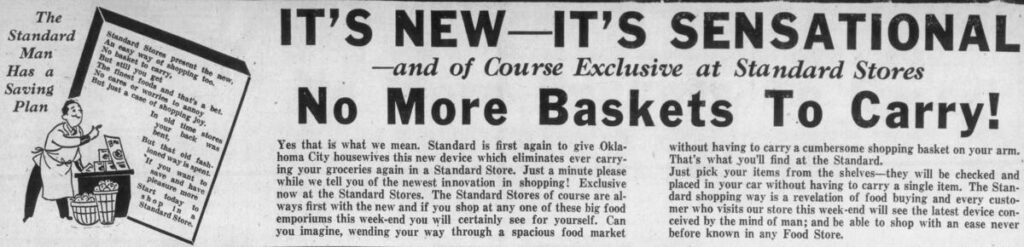
On June 4, 1937, Goldman ran a newspaper ad that introduced a “new device” that would let shoppers move through a store without carrying anything, teasing, “Can you imagine wending your way through a spacious food market without a cumbersome basket?” The ad promised, “It’s new, it’s sensational. No more baskets to carry,” but didn’t reveal the device, hoping curiosity would draw people into his markets.
“This was the greatest innovation in self-service I was giving them, but nobody wanted it,” Goldman said. A week later, he ran another ad claiming, “Shoppers came, saw and said, ‘It’s a wow.’” Goldman later admitted with a laugh, “It was the biggest lie.” The idea wasn’t catching on. Store managers worried children would crash carts into shelves, knock over cans and bottles, or run into each other. Some said no amount of insurance could cover the risk if someone got hurt. Goldman pushed ahead anyway. He hired men and women to pose as shoppers using the carts so others would see how they worked. Greeters stood at the entrance to explain them, and he promoted a “No Basket Carrying Plan.” Within weeks, people began to use shopping carts. Demand quickly grew so fast in Oklahoma City that Goldman couldn’t keep up. Soon, shopping carts spread across the country. By 1940, they were so popular that buyers faced a seven-year waiting list.
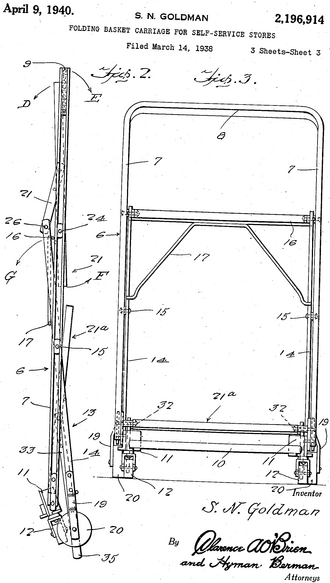
Goldman never became widely famous for his invention, but it made him extremely wealthy. His patent earned royalties on millions of carts sold and turned him into a multimillionaire. He even took to wearing gold cufflinks shaped like known for his gold shopping carts.
But the early carts weren’t perfect. They were bulky and awkward to move, didn’t store easily, and often had to be set up and handled by store employees, adding extra work behind the scenes.
The Nesting Cart
While Goldman made the shopping cart possible, Kansas City engineer Orla E. Watson made them practical for every supermarket to use. His 1946 “nesting” carts featured a hinged rear gate that allowed each cart to slide into the next, much like folding chairs stacking together. This made it possible for stores to store large numbers of carts in a compact space and for employees to collect and move them more efficiently. Watson’s practical design became the foundation for the modern shopping cart still used in supermarkets today. Without nesting carts, stores would have been overwhelmed by hundreds of bulky, non-stackable carts piling up around entrances and taking up valuable space. Employees would have needed much more time and effort to move and store them, taking space away from customers and merchandise.
Watson’s nesting cart was the final step in the shift from personal baskets to shared, in-store shopping carts. But World War II slowed their widespread adoption. Beginning in 1942, food rationing restricted how much of certain items shoppers could buy. The “red tape” of the point system favored large supermarkets over small neighborhood grocers, since chains were better equipped to manage complex rationing rules. As a result, customers increasingly made fewer, larger “haul” trips to supermarkets instead of frequent small visits. At the same time, production of new carts came to a halt. The War Production Board classified steel and aluminum as “essential” materials for the war effort, redirecting them away from consumer goods. Although Goldman had a large backlog of orders by 1940, his factories were shifted to wartime production. Shopping carts entered a kind of “frozen era,” with existing metal carts repaired and reused until the war ended when production resumed.
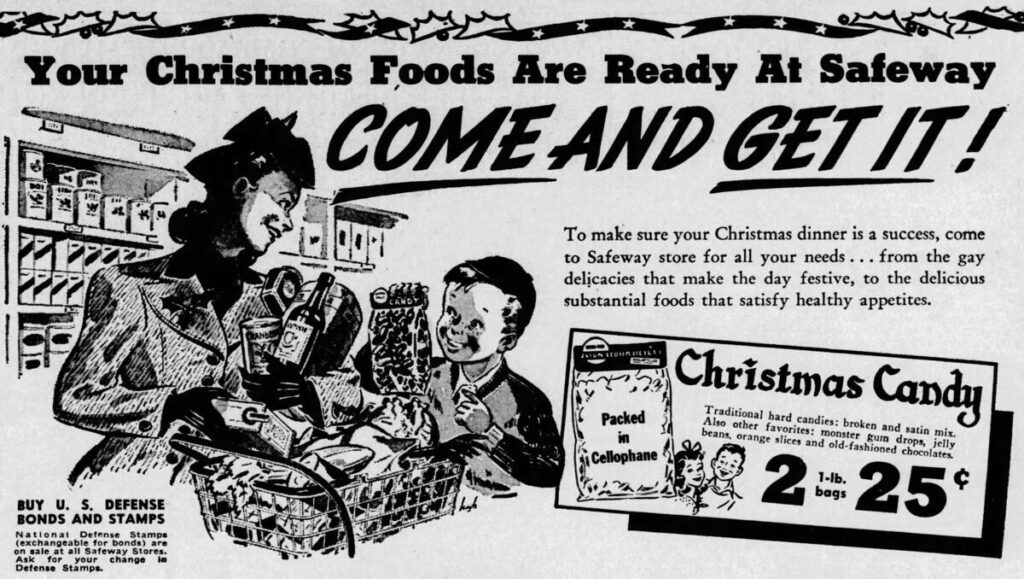
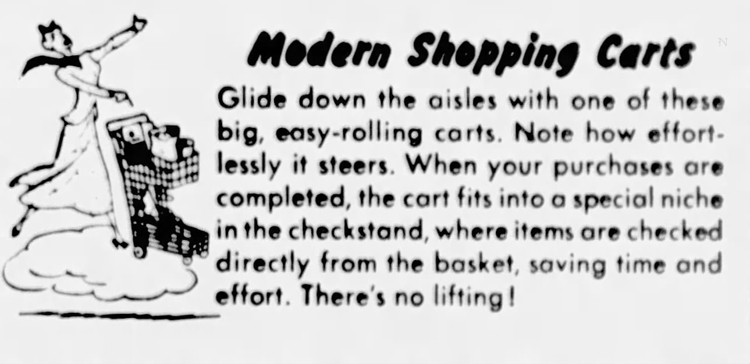
While Goldman’s original cart design appears in Safeway ads between 1941 and 1946, it was closer to 1950 before Ventura stores had acquired Watson’s carts which had become the industry standard. In 1950, Ventura County Star Safeway ads promised customers could “glide down the aisles” with “big easy rolling carts,” with “no lifting,” as carts fit directly into checkout stands “saving time and effort.” By then, Ventura’s grocery system had clearly entered a new era.
The Supermarket’s Golden Age
Postwar suburban growth fueled the supermarket’s “golden age” in the 1950s and 1960s. Chain stores were now firmly established, and while the number of individual stores declined, their size and efficiency increased significantly. Shopping habits also changed as more people owned cars and could travel farther to buy groceries in one trip rather than shopping locally. Ventura was poised to enter this new postwar era of large-scale supermarkets, suburban shopping patterns, and the widespread use of shopping carts.
In a 1955 column in the Ventura County Star, Betty Wentworth captured a moment when shoppers were still learning how to use carts and navigate larger supermarkets. She offered practical tips on learning a skill that seems routine today. Her advice reads like a guide to navigating an unfamiliar system: organize your list by departments, move through aisles in a steady, one-way flow, and group items in the cart, so checkout is faster and smoother. She emphasized efficiency, keeping price tags visible, pairing sale items correctly, and arranging groceries for easy bagging. She also stressed courtesy and safety, like pulling out of traffic when stopping and keeping children secure.
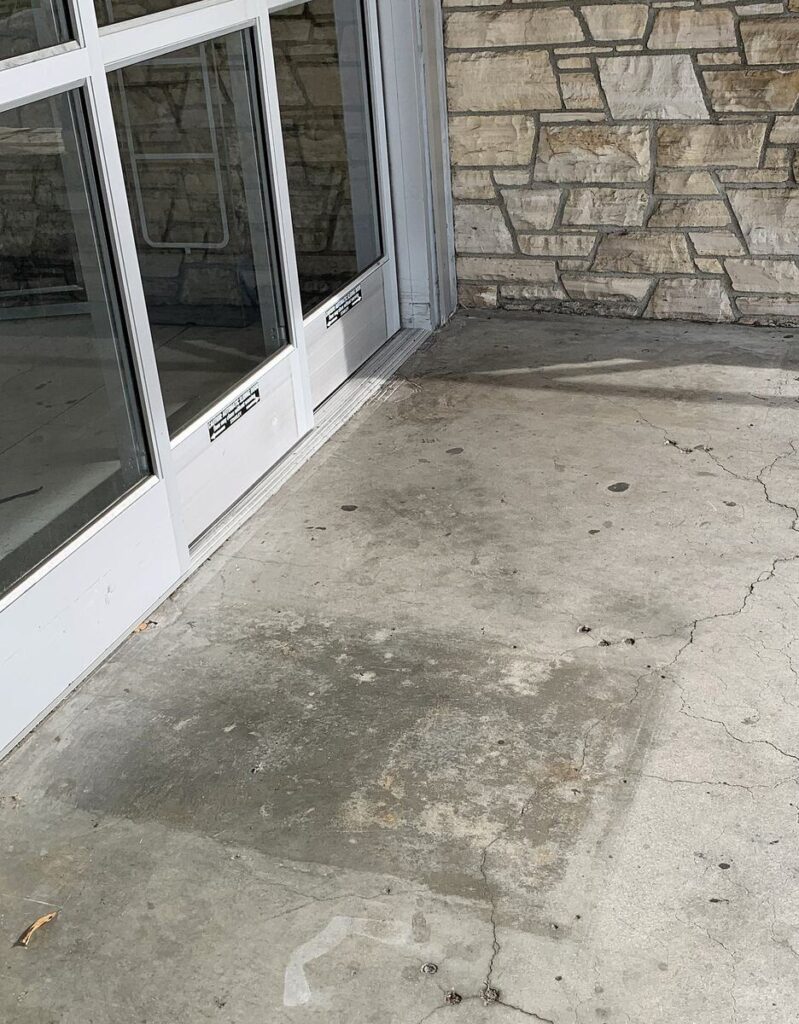
The shopping cart helped inspire automatic doors. Getting out of a store with a full cart was a challenge. In 1956, Safeway announced the “Magic Carpet” system in the Ventura County Star that opened doors automatically. Instead of today’s motion sensors, it used a pressure-sensitive rubber mat on the floor. When a shopper with a heavy cart rolled onto the mat, the weight triggered a mechanism that opened the door. Safeway noted this was especially helpful for customers pushing fully loaded carts out to the parking lot.
Stores and Shopping Carts Evolve
In 1957, the Ventura County Star ran a column by United Press writer Doc Quigg that took a humorous but insightful look at the fast-changing supermarket world. He imagined stores growing into all-in-one spaces where customers might one day handle banking or even buy a helicopter alongside groceries. He noted that supermarkets were already expanding, adding playrooms, snack counters, and services that made them feel like modern versions of the old general store. At the same time, he pointed out real problems, crowded aisles and confused shoppers, and predicted stores would need better organization, suggesting ideas like motorized carts, store maps, and even traffic controls. While some of his ideas were exaggerated, his main point proved right: supermarkets would become larger, more complex, and focused on convenience and customer experience.
As the new supermarkets opened in the 1960’s, the stores highlighted new, strong, easy-rolling shopping carts. A 1960 ad in the Conejo News for the opening of a Von’s store in Thousand Oaks touted “the fact that we have plenty of shopping carts, handily located.” A new Von’s store in Ventura at 2764 E. Thompson Boulevard boasted of “38,600 square feet of floor space and the newest and best of modern fixtures and equipment” including “new stainless steel shopping carts are each equipped with a folding seat for the tired toddler.” The store also featured “Magic Carpet”‘ automatic doors, and “wider aisles than most supermarkets.” Vons and later Ralphs came to define Southern California grocery shopping. Both began as single-store businesses in Los Angeles before expanding into Ventura County, where they helped drive the consolidation of the grocery industry and the rise of the modern supermarket.
Shopping Cart Injuries
As soon as carts were rolling along the aisles, their safety had become a public concern and a source of amusement in the newspapers. An Associated Press story in the Ventura County Star described a Philadelphia X-ray technician’s “strangest case in 20 years: A woman run over by a shopping cart in a Germantown supermarket.” In 1957, the Oxnard Press-Courier ran an article describing how a federal judge had ruled in favor of a supermarket which was sued by a shopper who was hit by a shopping cart pushed by a four-year-old girl.
Most shopping cart injuries, even today, involve children. Child seats were added to shopping carts in the 1950’s as a convenience. Injuries led to the introduction of child seat belts in the 1960s. The most recent figures, from 2023, showed that 27,500 people were treated in emergency rooms for shopping cart injuries. While many of these injuries were minor bruises, cuts, and sprains, about 10 to 15 percent were more serious, including fractures and head injuries from falls or cart tip-overs. Adults are more likely to experience injuries from collisions or carts rolling over their feet. Adults over 65 are more than twice as likely as younger adults to fall when using carts for balance while shopping.
When Carts Started Disappearing
In 1958, the Whittier East Review described a growing and costly problem: shopping carts disappearing from supermarkets across Southern California. Some were left scattered in parking lots where they could be damaged, others were taken home by shoppers, who underestimated their value and abandoned them in alleys, ravines, or backyards. Grocers quoted in the East Review article estimated that more than 1,000 carts were lost each week, costing stores over $1.6 million. They appealed to the public to return carts or report abandoned ones to reduce the cost that would inevitably be shared by the consumer.
The problem has only grown worse. Recent estimates suggest that about two million shopping carts are stolen or go missing each year in the United States, creating a significant cost for retailers, roughly $175 million annually in replacement and repair costs. Individual carts typically cost anywhere from about $75 to several hundred dollars each.
Ventura’s 2012 “Safe and Clean Public Places” ordinance required businesses to keep shopping carts on their property and actively retrieve any that left the premises. It also allowed the city to fine businesses or impound carts if they failed to control or recover them. The law established the rule that stores with 10 or more carts must use a physical containment system, such as wheel locks or perimeter barriers, to keep carts from leaving the property. One of the main motivations behind the law was the growing number of carts being taken and used to transport personal belongings by unhoused people. City officials and local reporting at the time made clear that abandoned carts had become a costly blight as they were increasingly showing up in encampments, riverbeds, and neighborhoods. While the ordinance did not directly target the unhoused, it was widely understood as part of a larger effort to manage the visible impacts of homelessness in Ventura by addressing one of its most recognizable symbols – the abandoned shopping cart.
Oxnard’s shopping cart law is rooted in its 1960’s-era municipal code and reflects an enforcement-driven approach. It primarily treats abandoned carts as a public nuisance, making it illegal to remove or possess them off store property and relying on city enforcement and penalties after carts are taken.
More expensive solutions, such as wheel locks, deposit systems and GPS tracking are often seen as a burden to smaller grocers and businesses. Most cities and unincorporated areas of Ventura generally follow state law which makes it illegal to remove carts, but do not force stores to install expensive locking wheel technology.
In October 2025, Senate Bill 753 allowed Ventura County or cities like Ventura to pick up abandoned carts immediately and return them directly to stores, instead of waiting days or storing them in impound lots. It also lets them charge retailers for the actual cost of retrieval (up to set limits) and impose higher fines if stores fail to recover carts, increasing the incentive for businesses to control their carts. Today, Ventura directs shopping cart retrieval questions to the CarTrac Online hotline. CarTrac, part of Retail Marketing Services, a for-profit arm of the California Grocers Association, runs a statewide program that helps retailers recover lost carts and comply with local laws.
Bigger Loads, Lighter Designs, New Technology
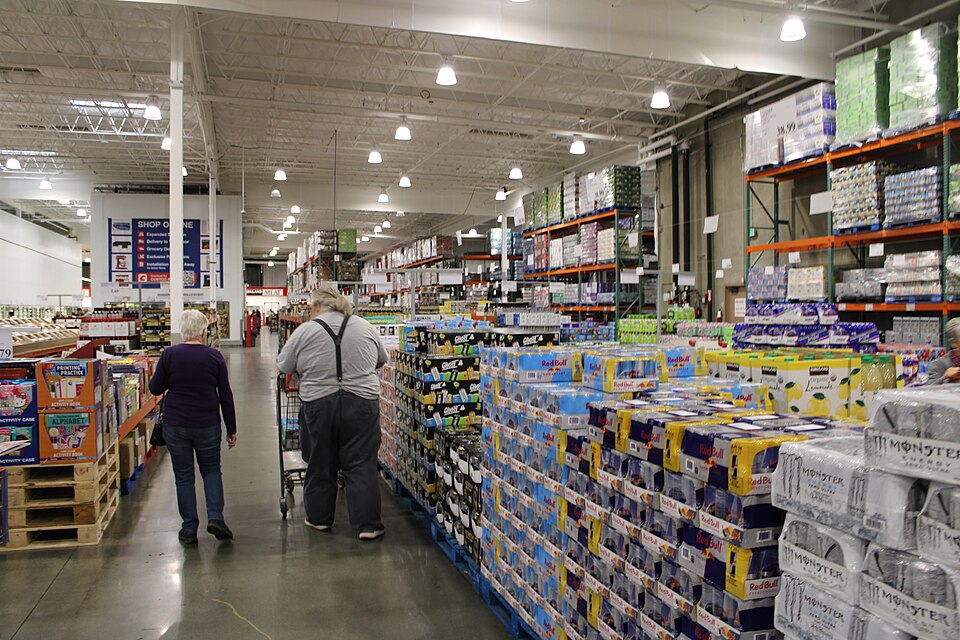
By the late 20th century, grocery retail split into new directions. Costco Wholesale emerged in the 1980s as part of the warehouse club model, built around bulk buying, essentially pushing the shopping cart to its extreme, where customers filled oversized carts and loaded rolling platform dollies with large-quantity goods for fewer, bigger trips. At the same time, a different wave followed. Stores like Trader Joe’s, Sprouts Farmers Market, WinCo Foods, and Grocery Outlet took another path with smaller stores, curated selections, and discount pricing.
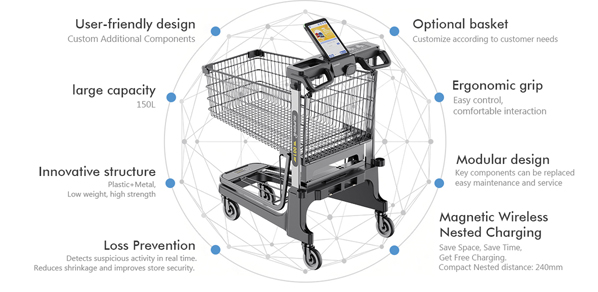
During the 1970s and 1980s, carts became more user-friendly, with features like plastic handles and rubber bumpers to prevent damage in crowded store aisles. In the 1990s, many designs shifted toward lighter materials, including plastic carts, along with more ergonomic handles for comfort. In the 2000s, hybrid designs that blended baskets and carts began to appear. Post-pandemic concerns over bacteria on handles have led to built-in wipes on shopping carts. More recently, carts have started incorporating technology, such as phone holders, barcode scanners, and digital screens. Some experimental “smart carts” even include built-in tablets and automated checkout systems. But even the most advanced “smart carts” still look and function like traditional carts, just with added technology. Sensors, scanners, and AI tend to attach themselves to the existing design rather than replace it.
After decades of change, the shopping cart isn’t disappearing; it’s evolving. The basic idea, a wheeled basket you push through a store, turns out to be one of the most efficient and lasting retail inventions ever created.
Make History!
Support The Museum of Ventura County!
Membership
Join the Museum and you, your family, and guests will enjoy all the special benefits that make being a member of the Museum of Ventura County so worthwhile.
Support
Your donation will help support our online initiatives, keep exhibitions open and evolving, protect collections, and support education programs.
Bibliography
- Alameda Times Star (Alameda, CA). “Shopping Cart Aids Women.” January 12, 1940, 2.
- Brittell, Cherie. “Roaming in the Marts.” Morning Free Press (Ventura), May 15, 1928, 5.
- “Cart Control: Strategies to Combat the Epidemic of Missing and Stolen Shopping Carts.” Total Retail. Accessed May 5, 2026. https://www.mytotalretail.com/article/cart-control-strategies-to-combat-the-epidemic-of-missing-and-stolen-shopping-carts/.
- Chriss, Nicholas C. “Great American Success Story: the Shopping Cart.” The Los Angeles Times, April 11, 1977, 1.
- “City of Ventura Historic Landmarks and POI (v.20170511.” VENTURA Maps – GIS Maps and Services for the City of Ventura, California. Accessed May 5, 2026. https://map.cityofventura.net/java/historic/search.htm.
- Conejo News (Thousand Oaks, CA). “Vons Ad.” September 12, 1960, 2.
- East Review (Whittier, CA). “Cart Napping Costs Passed to Customer.” January 23, 1958, 11.
- “Feraud General Merchandise Store.” Wikipedia, the Free Encyclopedia. Last modified August 28, 2025. https://en.wikipedia.org/wiki/Feraud_General_Merchandise_Store#:~:text=The%20building%20was%20listed%20on,1903.
- “Food for Thought & What’s In Store With “The Daley News,” Daley’s Incorporated Chain Store Grocers, Los Angeles, 11 January 1926 -The Homestead Blog.” The Homestead Blog. Last modified January 12, 2024. https://homesteadmuseum.blog/2024/01/11/food-for-thought-whats-in-store-with-the-daley-news-daleys-incorporated-chain-store-grocers-los-angeles-11-january-1926/#:~:text=The%20Express%20of%20the%207th,that%20number%20in%20two%20years.
- “Groceteria.com.” Groceteria.com – Exploring Chain Supermarket History. Last modified July 4, 2009. https://www.groceteria.com/about/a-quick-history-of-the-supermarket/.
- “Lost in the Supermarket: Why Shopping Carts Get Stolen So Much.” Amaturo Sonoma Media Group. Accessed May 5, 2026. https://www.sonomamediagroup.com/lost-in-the-supermarket-why-shopping-carts-get-stolen-so-much/?utm.
- Martinez, Arlene. “Ventura Cracks Down on Carts.” Ventura County Star, January 25, 2012, 13.
- Morning Free Press (Ventura). “Ad: Piggly Wiggly Opens March 7.” March 3, 1925, 4.
- Morning Free Press (Ventura). “Ad: Piggly Wiggly.” May 8, 1925, 3.
- Morning Free Press (Ventura). “Ad: Piggly Wiggly.” March 13, 1928, 2.
- Morning Free Press (Ventura). “Increase in Stock by Piggly Wiggly.” July 6, 1928, 8.
- Morning Free Press (Ventura). “New Company to Take Over Store.” March 15, 1926, 1.
- Morning Free Press (Ventura). “New Piggly Wiggly Meat Market Opens.” June 12, 1925, 6.
- Morning Free Press (Ventura). “New York.” August 23, 1923, 1.
- Morning Free Press (Ventura). “Piggly Wiggly to Open on Saturday.” March 5, 1925, 1.
- Morning Free Press (Ventura). “Piggly-Wiggly Pays.” August 13, 1923, 1.
- Morning Free Press. “Safeway Stores Lease Locations.” April 9, 1927, 1.
- Morning Free Press (Ventura). “Safeway Stores to Open Tomorrow.” May 20, 1927, 1.
- Morning Free Press (Ventura). “System Was Organized 12 Years Ago This Month.” October 1, 1928, 1.
- Morning Free Press (Ventura). “To Open Second Piggly Wiggly.” May 10, 1926, 1.
- Morning Free Press (Ventura). “Town Topics.” September 1, 1925, 6.
- Oxnard Press-Courier. “Beware the Child.” April 25, 1957, 5.
- Oxnard Press-Courier. “Safeway Stores Inc. Take Long Lease on Wineman Building; To Open Grocery Store and Market.” April 19, 1927, 1.
- “Piggly Wiggly.” Wikipedia, the Free Encyclopedia. Last modified April 22, 2026. https://en.wikipedia.org/wiki/Piggly_Wiggly?utm.
- Quigg, Doc. “Future Improvements in Supermarkets Answer All Needs.” Ventura County Star, July 26, 1957, 7.
- “SB 753: Special Business Regulations: Shopping Carts.” Digital Democracy | CalMatters. Last modified October 13, 2025. https://calmatters.digitaldemocracy.org/bills/ca_202520260sb753#utm.
- “SB-753: What California Retailers Need to Know.” Gatekeeper Systems. Last modified November 4, 2025. https://www.gatekeepersystems.com/resources/insights/sb-753-what-california-retailers-need-to-know/#:~:text=Insights%20Article,carts%20found%20off%20their%20property.
- Sheridan, Sol N. History of Ventura County, California. Chicago: S.J. Clarke Publishing Co, 1926.
- “Shopping Cart Safety for Children.” HealthyChildren.org. Accessed May 5, 2026. https://www.healthychildren.org/English/safety-prevention/on-the-go/Pages/Safe-Shopping-With-Children.aspx?utm.
- “Shopping Cart-Related Lower Extremity Injuries Treated at United States Hospital Emergency Departments.” Lower Extremity Review Magazine. Last modified October 10, 2024. https://lermagazine.com/cover_story/shopping-cart-related-lower-extremity-injuries-treated-at-united-states-hospital-emergency-departments#:~:text=The%20annual%20estimated%20number%20of,decreasing%20to%2027%2C532%20in%202023.
- Sjoden, Kerstin. “June 4, 1937: Humpty Dumpty and the Shopping Cart.” WIRED. Last modified June 4, 2009. https://www.wired.com/2009/06/dayintech-0604/?utm.
- Ventura County Star. “Ad: Distribution Without Waste.” May 20, 1927, 5.
- Ventura County Star. “Ad: Just Remodeled Safeway Stores.” January 26, 1950, 7.
- Ventura County Star. “Ad: Piggly Wiggly.” October 7, , 6.
- Ventura County Star. “Ad: The System Must Be Right to Grow as It Does.” September 8, 1926, 5.
- Ventura County Star. “Gala Festivities Mark Opening of Von’s Market.” October 26, 1960, 34.
- Ventura County Star . “New Innovations in Safeway Store.” March 7, 1956, 9.
- Ventura County Star. “New Store Far Cry From Start.” October 26, 1960, 35.
- Ventura County Star. “Shopping Cart Wreck in Philadelphia.” April 30, 1957, 13.
- Ventura County Star. “Ventura Cracks Down on Carts.” January 25, 2012, 64.
- Ventura Daily Post. “James Blackstock to Remain on Job.” October 22, 1924, 1.
- Ventura Daily Post. “Piggly Wiggly.” November 8, 1924, 7.
- Ventura Daily Post. “Piggly-Wiggly Corporation Buys Blackstock Grocery Store.” October 11, 1924, 1.
- The Ventura Weekly Post and Democrat. “Ad: A Home Institution.” January 23, 1931, 5.
- The Ventura Weekly Post and Democrat. “George Porter In Business for Self.” September 4, 1925, 7.
- The Ventura Weekly Post and Democrat. “New Piggly Wiggly Store Opens June 26.” June 18, 1926, 1.
- The Ventura Weekly Post and Democrat. “Piggly Wiggly Mgr. Explains Its System.” March 6, 1925, 2.
- The Ventura Weekly Post and Democrat. “Santa Cruz Market to Open Tomorrow.” May 19, 1944, 9.
- “Ventura-Oxnard Chain Grocery/Supermarket Locations, 1924-1981.” Groceteria.com – Exploring Chain Supermarket History. Accessed May 5, 2026. https://www.groceteria.com/place/california/ventura-area/.
- Wentworth, Betty. “Betty Wentworth Reporting.” Ventura County Star , February 25, 1955, 5.
- “Where Are the Missing Shopping Carts?” The Hustle Daily Newsletter. Last modified October 1, 2024. https://thehustle.co/01242023-missing-shopping-carts.