by Library Docent Volunteer Andy Ludlum
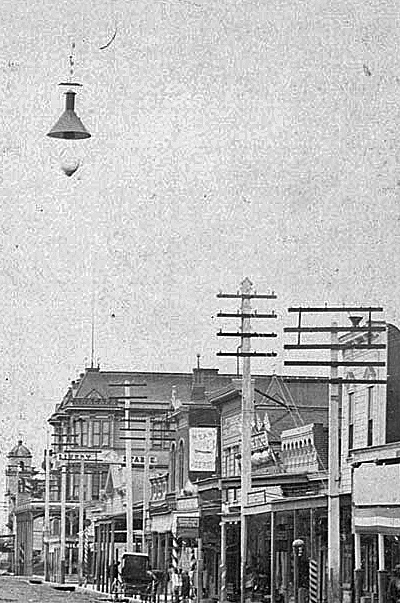
It was 3 a.m. on July 5, 1890. On Ventura’s dark Main Street, a team of laborers moved quietly but quickly along the dirt roadway, guided only by the flickering glow of handheld lanterns. They carried long, redwood poles, heavy and unwieldy, laid end to end on wagons or dragged on the ground. Working by lamplight, the crews marked each location, then, sweating, they dug deep holes by hand with shovels and augers into the compacted earth. Once a hole was ready, several men wrestled a pole upright, steadying it with ropes and wooden braces while others packed dirt firmly around its base to keep it straight and secure. As the first light of dawn crept over the town, copper wire began to appear. Men pulled, bent, and tied the heavy strands between supports, climbing on ladders and balancing on crossarms as they strung the wire from pole to pole with simple insulators mounted near the top. By 10 a.m., thorough their sheer will, they turned the hurried network of timber and copper into a functional electrical grid. And a territorial struggle over the town’s future began.
The Technological Landscape of 1890
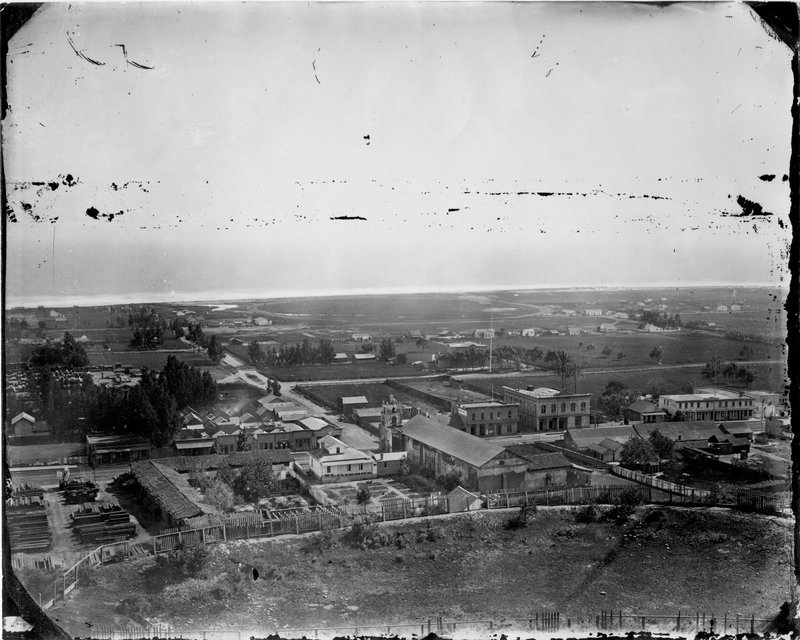
In the late nineteenth century, Ventura was defined as much by darkness as by geography. The town followed a familiar daily rhythm. By day, it functioned as a busy agricultural center and county seat, positioned between the growing city of Los Angeles and the more settled community of Santa Barbara. By night, Ventura faded into darkness, its streets and homes lit only by oil lamps and gaslight. Life after sunset slowed to a near standstill. That changed in the summer of 1890. Between June and September, Ventura experienced a dramatic transformation as electric lighting arrived. The change was not simply a civic improvement. It was political and economic, tied to the debate over how electricity would be generated and delivered to the public. It reflected the fierce corporate competition of the time. Most importantly, it altered daily life itself, changing how residents saw, worked, and moved through their town after sunset. To understand the impact of August 1890, it helps to picture life before electricity.
The Incumbent: Gas and Kerosene
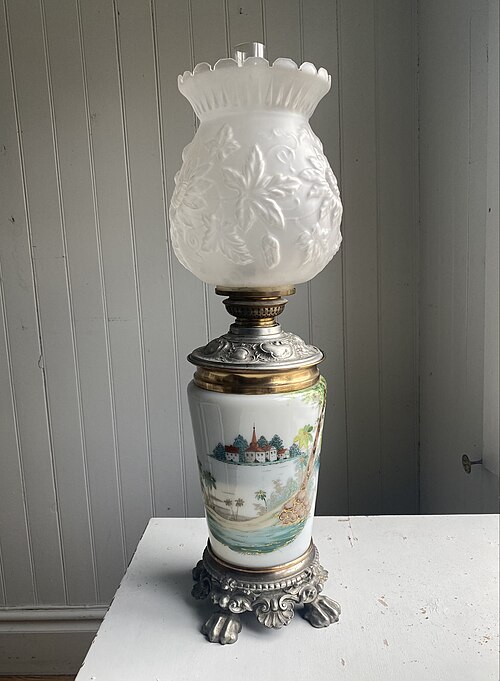
Light came from kerosene for most Ventura households in the 1890s. By this time, kerosene was a well-established fuel, refined from petroleum and widely sold. A simple lamp used a wick to draw oil from a small reservoir, with a glass chimney protecting and shaping the flame. The light it produced was a small, steady, amber-colored glow. It was just enough light for a table or chair, leaving most of the room in shadow. Using inexpensive kerosene lamps required daily effort. Wicks had to be trimmed, lamps cleaned of soot, and the oil refilled regularly.
Street lighting in Ventura was provided by gas lamps operated by the Ventura Gas Company. The company was established in 1887. Initially, the company focused on providing the gas which was made from coal and piped through an underground network of iron pipes to streetlamps and a small number of well-to-do businesses. Streetlamps used simple burner tips, which produced modest light and flickered easily. They burned with a yellow-orange glow that often struggled against wind and coastal fog. Gas street lighting benefited from a centralized supply, so lamps did not need daily refilling. However, the system lacked flexibility. Expanding service required tearing up streets to lay new pipes, making growth slow and costly.
The Challenger: Electric Light
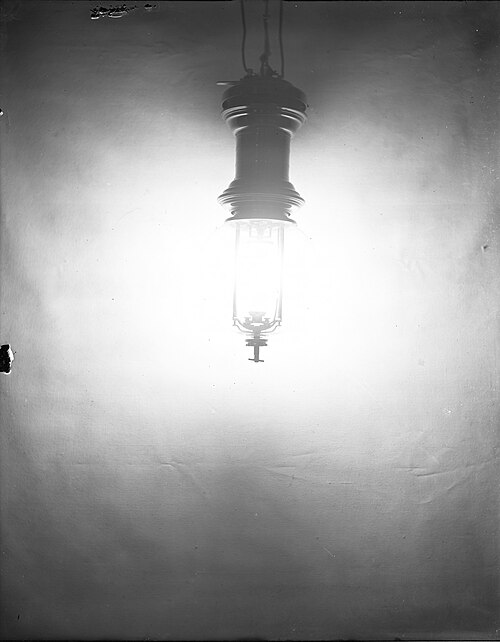
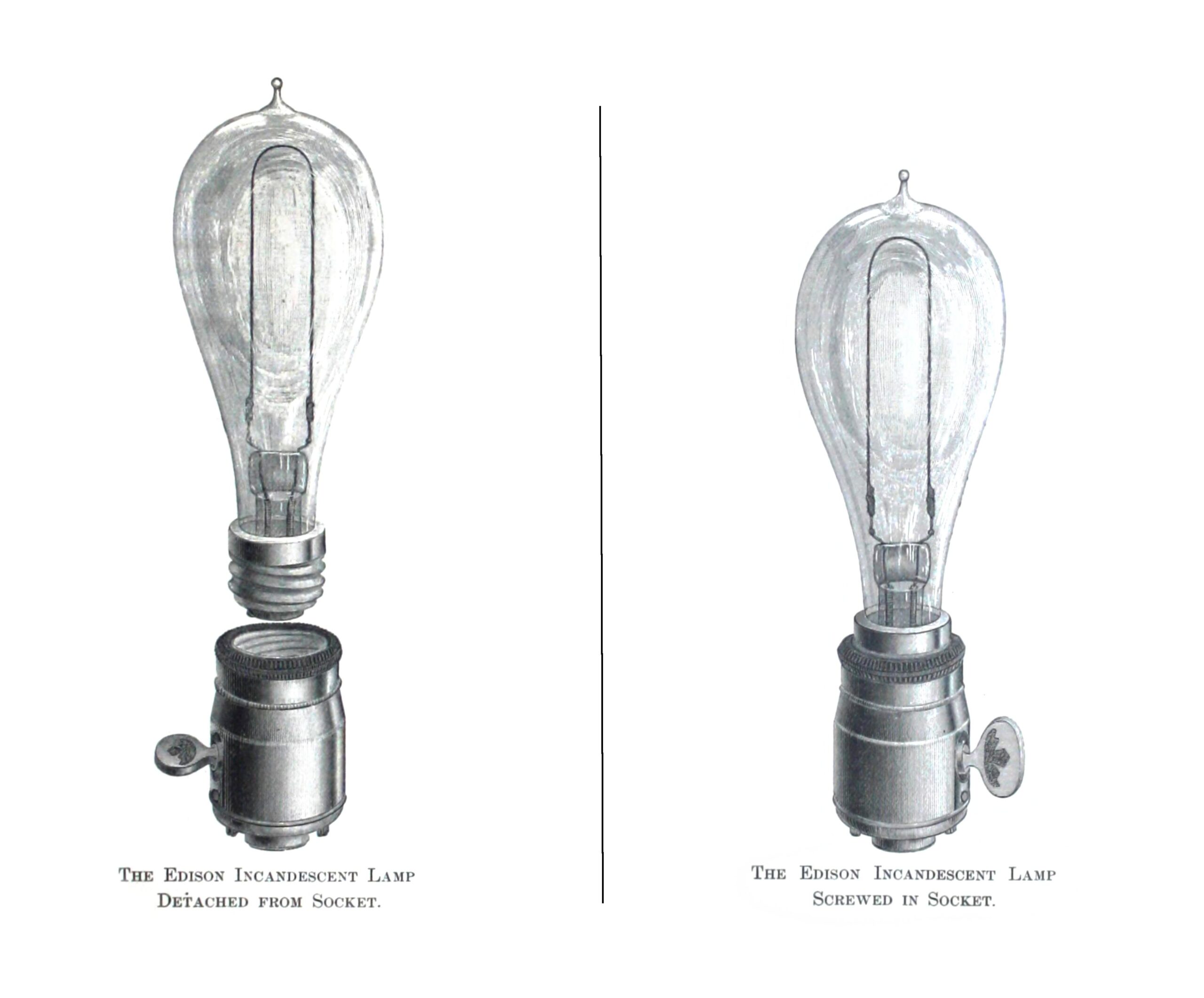
Into this world of gas and flame came a new and unsettling technology: electric lighting. Unlike oil or gas lighting, it did not rely on combustion. Instead, it produced light through raw electrical energy. By 1890, electric lighting was split between two very different technologies, each with its own equipment and purpose. For streets and public spaces, the most powerful option was the carbon arc lamp, and this was the system chosen for Ventura’s street lighting. An arc lamp worked by sending a high-voltage electric current between two carbon rods. When the rods were pulled slightly apart, the electricity jumped the gap, creating an intensely bright arc of superheated light. The result was astonishing. A single arc lamp produced light a hundred times brighter than a gas lamp. It flooded streets with a blue-white glare and cast sharp, dramatic shadows. The light hissed and buzzed, was harsh to the eyes, and even produced ultraviolet radiation. For indoor spaces, different technology was used. Incandescent lamps relied on a thin carbon filament sealed inside a vacuum. They produced a much softer glow, far dimmer than arc lights, but were well suited for hotels, stores, and homes. Ventura’s electric plan combined both systems: powerful arc lamps to light the streets, and gentler incandescent bulbs for interior spaces where comfort mattered more than brilliance.
The transition to electricity would become a commercial conflict driven by ambitious men. It pitted the established Ventura Gas Company against the emerging industrial developers of the Ventura Land and Power Company.
Ventura Land and Power Company
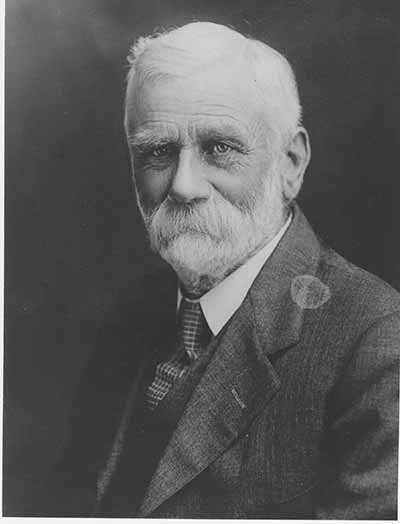
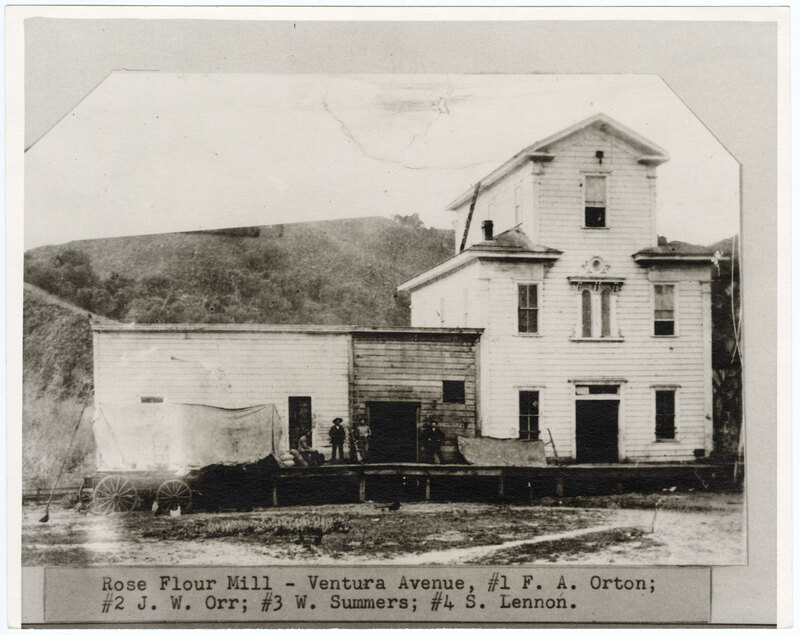
The Santa Ana Water Company was incorporated on January 10, 1870, with trustees that included Thomas R. Bard, Walter S. Chaffee, and William S. Patterson. Its goal was to build a dam on the Ventura River and supply water for irrigation and for domestic use in the town of San Buenaventura. Although focused on water, the company also saw the power potential of its waterways. In early 1890, it formed a subsidiary, the Ventura Land and Power Company, to manage land in Ventura and develop hydroelectric power to generate electricity for the town. The company was led by Eugene Preston (E.P.) Foster, a banker and investor who had come to California by covered wagon and later became president of the Bank of Ventura. Foster believed that improving public infrastructure would strengthen the town and increase the value of his investments in agriculture, oil, and real estate. His involvement with water began when Chaffee, owner of the Ventura Water Company, convinced him to serve as superintendent for $40 a month, a position he held for several years through multiple ownership changes. Foster partnered with Gilpin Wallace Chrisman, a pioneer farmer and land developer. Together, they connected two industries by building both an ice plant and an electric plant, recognizing that refrigeration and electric lighting could support Ventura’s agricultural economy. The Ventura Land and Power Company planned to light Ventura by using its control of Ventura River water rights and its ownership of the Rose Flour Mill. During the day, water powered the mill to grind grain; at night, the same water was diverted south of the mill to run a dynamo and generate electricity.
Ventura Gas and Electric Light Company
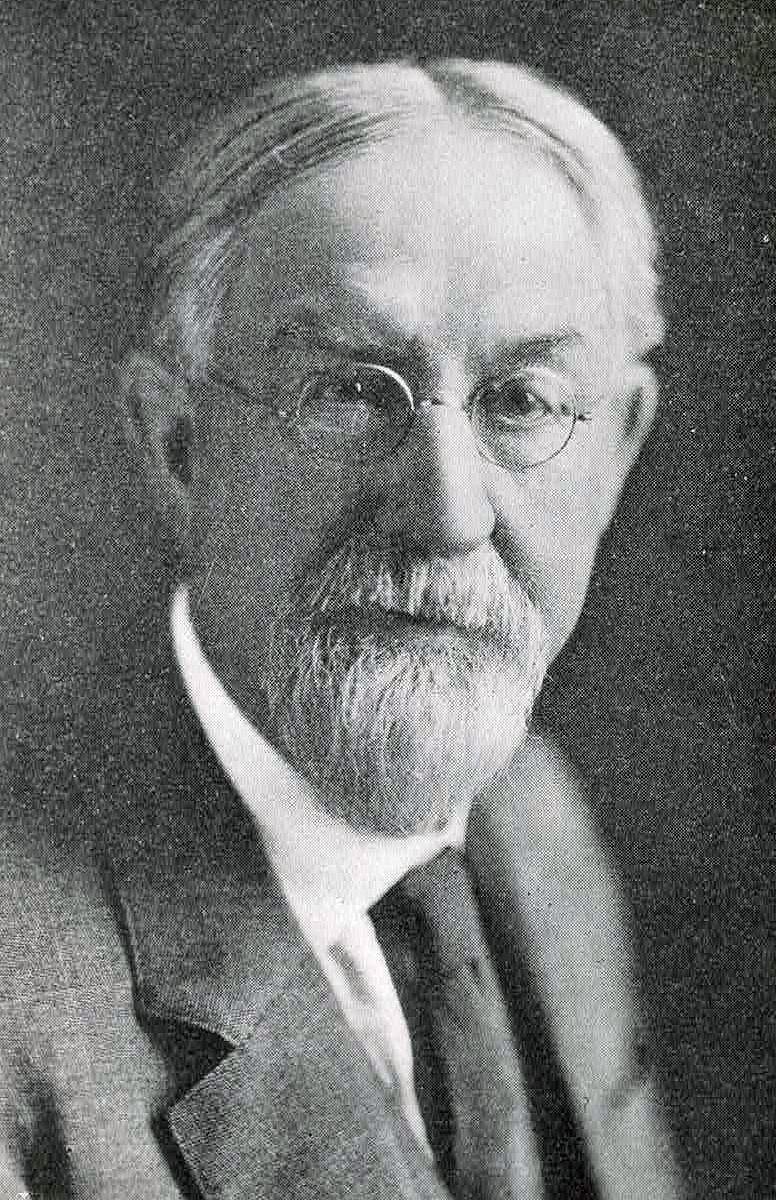
The Ventura Gas Company was the town’s established energy provider, supplying gas for lighting and heating. As electricity gained popularity, the company adapted. In 1890 it renamed itself the Ventura Gas and Electric Light Company, signaling its intent to expand into electric power. Electricity was both an opportunity and a challenge. Without cheap waterpower, Ventura’s gas company had to rely on costly gas or steam engines to generate electricity. Ventura’s utility was part of a much larger reshaping of the region’s energy industry. In 1886, 20-year-old Christian Otto Gerberding Miller and 23-year-old Walter Branks Cline founded the Pacific Lighting Company in San Francisco, using new technologies such as the Siemens gas lamp. The company quickly expanded into Southern California by purchasing three Los Angeles-area gas and electric firms, including the Los Angeles Gas Company. In 1889, Cline moved to Los Angeles to become president of the newly acquired company. Over the next two years, Pacific Lighting and its subsidiaries absorbed many smaller utilities into a growing regional network. Although the Ventura Gas and Electric Light Company remained formally independent in 1890, it was already tied to the Pacific Lighting system. The Ventura Free Press even referred to Cline as the “president of the Ventura Gas Company.” Newspaper accounts described Cline as a man with a strong sense of executive responsibility and a genuine love of work.
Contract and the Challenge
The story begins at Ventura’s Town Hall in May 1890, when the Ventura Land and Power Company announced plans to light the town, provided it could secure a municipal franchise. By early June, the Town Council agreed and awarded the company a one-year contract to install seven arc lamps at key intersections by September. Chrisman told town trustees that, considering the greater lighting power of arc lamps, he could provide light to Ventura “at about one-third of the cost at which gas is now supplied to them.”
The contract reflected the tight budgeting of a small town in the 1890s. The lamps were to operate from 6 p.m. until midnight for $12 per month, or $8 if service ended at 9 p.m. The “midnight schedule” shows how people of the era viewed nighttime: darkness was accepted once social activity ended, and running a generator after most residents were asleep was seen as unnecessary. To save more money, the generator was not to be operated during the full moon period each month. The Ventura Weekly Post and Democrat reported that the agreement called only for arc lights, since there were not enough subscribers to justify installing an incandescent system. Even so, the newspaper expected incandescent lighting would “follow in time.”
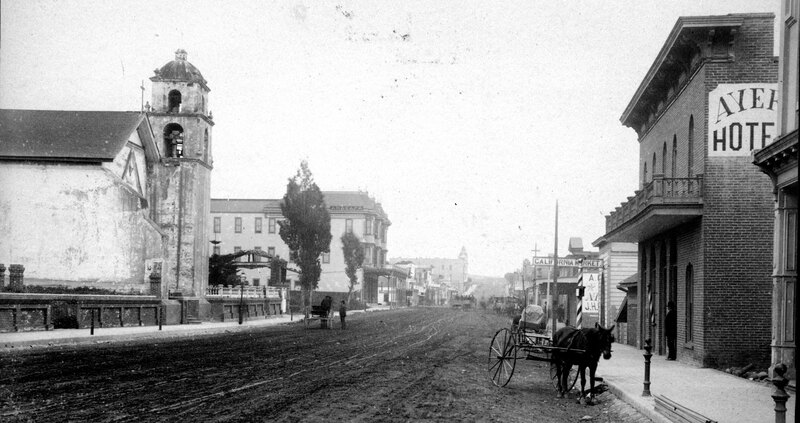
The Ventura Gas Company protested immediately. Cline argued that his company had not been given a fair and equal opportunity before the town trustees and challenged the legality of the Ventura Land and Power Company’s contract. He claimed that an 1887 agreement for gas lamps gave his company exclusive rights to build and maintain an electric plant in Ventura for five years. While admitting the Gas Company was a “for profit” business, Cline told the Board, “We have nevertheless had your town at heart and believe we have done full share towards making your town the prosperous place it now is.” Cline asked the Town Council to cancel its contract with Ventura Land and Power and instead call for competitive bids for electric lighting. He offered to supply six or more 2,000–candlepower arc lights, operating from sunset to midnight, at a cost not to exceed $10 per lamp per month, $2 less per lamp than the Ventura Land and Power contract.
After considerable discussion, the Council stood by Foster and Chrisman, trusting their strong local ties and favoring hydroelectric power as a more stable and economical source of electricity than costly steam-driven generation. Even after the rejection, The Ventura Weekly Post and Democrat reported on June 28 that the Gas Company had “begun work near the gas works on an electric plant and expect to have it in operation within thirty days.” A week later, the paper quoted Gas Company superintendent J. Warren, who said “that the machinery for the electric lights would be shipped to Ventura this week and be placed in position as fast as men and money could do it.”
Midnight Pole Raising
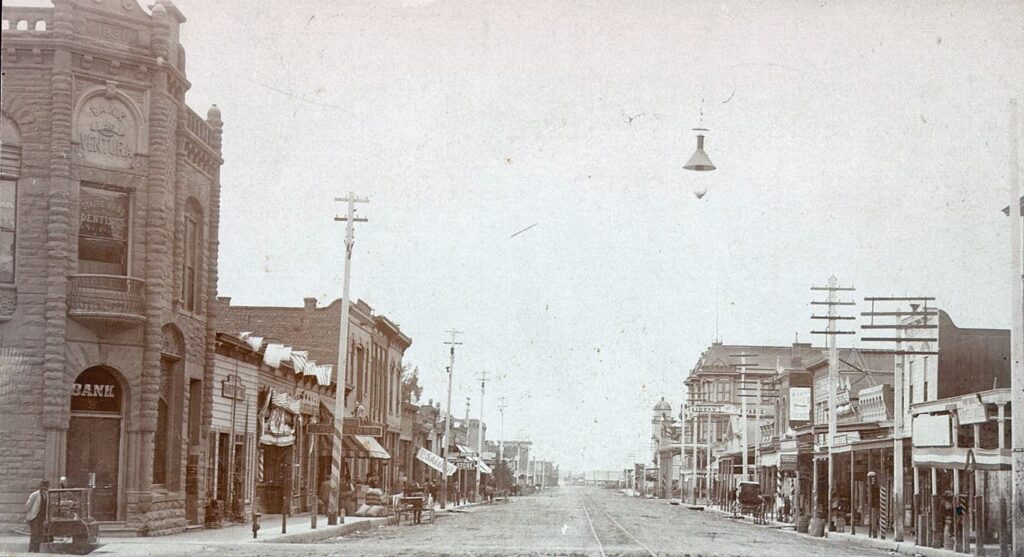
After losing the contract, the Gas Company took bold action. In the early hours of July 5, 1890, crews quietly began putting up poles along Main Street. Starting at Chestnut Street, they worked by lantern light, digging holes, setting heavy redwood poles, and stringing copper wire while the town slept. By mid-morning, a wired grid was already taking shape and the strategy was clear: claim the right-of-way through possession. The Gas Company was betting the town would hesitate to remove equipment that was already in place, even if it conflicted with the contract held by the Ventura Land and Power Company. As the wires were being strung, Frank Newby of the Gas Company told the Ventura Free Press that the company intended to push ahead with “rapid completion” of a full power plant, which he hoped to have operating as “soon as it was possible to shove the work along and complete it.”
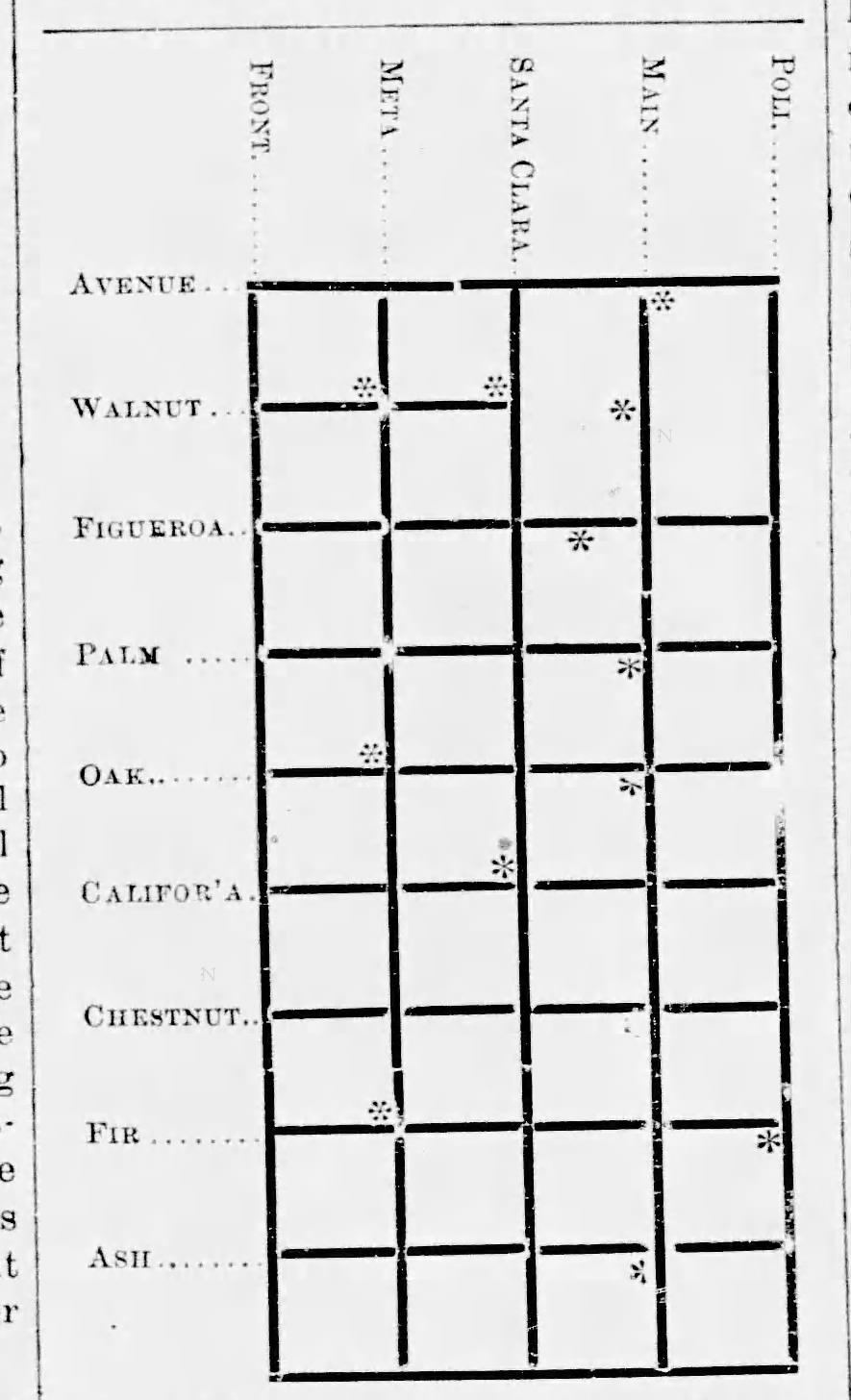
Rather than fight a costly, street-by-street battle, Chrisman said the Ventura Land and Power Company would move ahead with its plans, complete its $20,000 plant on schedule, and honor its lighting contracts. He told the Ventura Free Press that his company would place its poles and wires on the same side of Main Street as the Gas Company’s, but ten feet higher, “preventing any question of interfering with the rights acquired by the snapshot action of the Gas Company.” Later that month, the company secured a franchise from the county Board of Supervisors allowing it to “erect and maintain poles, masts, and other appliances along the public highways of Ventura County.” The rivalry drew public attention, and many townspeople assumed one company would eventually buy out the other. Chrisman rejected that idea, telling the Free Press he had “not the slightest idea” of compromising or selling any rights. He added that even if Cline and the Gas Company “should count down fifty thousand dollars in gold in the Ventura Bank…they would not be able to buy us out.” Newspaper editors welcomed the competition, concluding that Ventura “has a good chance of being well lighted.” They noted that the public was “generally the beneficiaries” of active rivalry, which would bring “oceans of water, floods of light and avalanches of low prices.” By July 25, the Land and Power Company had crews digging post holes while waiting for poles to arrive by steamer from Eureka. Two “experienced and practical electric light and power men,” H. R. Bowie and H. Curtis, were hired to supervise the work. The Ventura Free Press reported that 41 arc lamps would be installed at first, many “subscribed for by private individuals,” with 14 reserved for street lighting. The paper also published a map showing the planned locations of the streetlights.
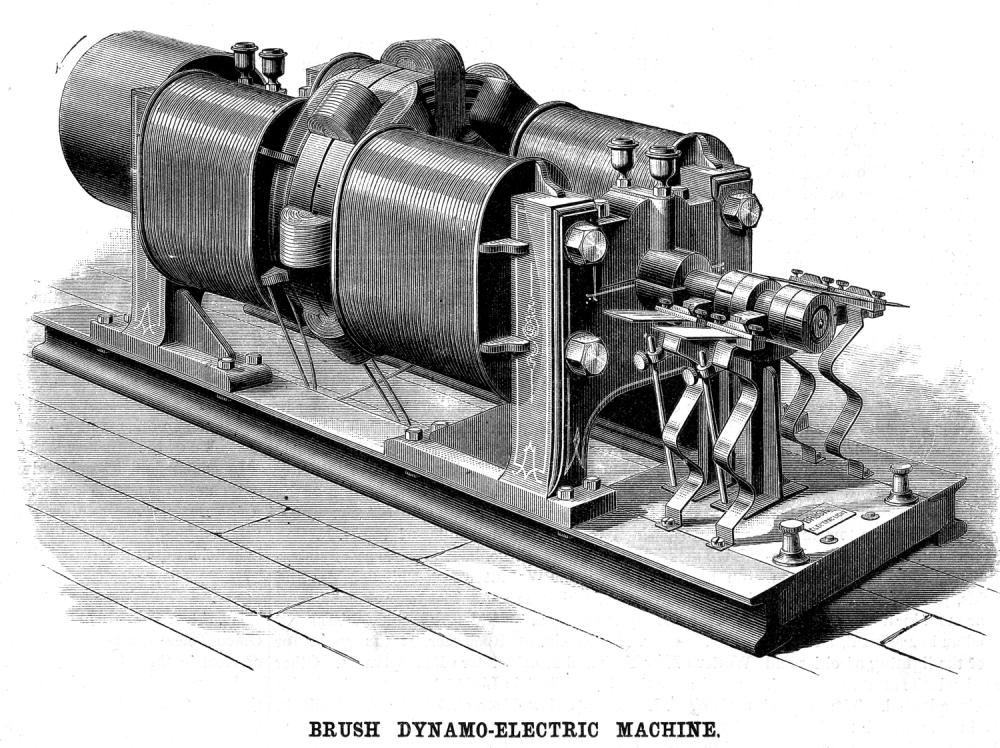
Chrisman had a key advantage the Gas Company lacked: the established water ditch at the Rose Flour Mill. Using a water wheel, he could turn flowing water into mechanical energy and profit. The system was both practical and efficient. During the day, the water powered the millstones to grind grain; at night, the same flow was diverted to drive a waterwheel connected to an electric dynamo. This clever “time-sharing” setup let Ventura Land and Power generate electricity without burning coal or oil. To make it work, the company ordered a large Brush arc-light dynamo—a massive machine of copper windings and rotating commutators, capable of producing thousands of volts to run up to sixty arc lamps, far more than the seven required by the town contract. But the plan almost failed: the water wheel built specifically to drive the dynamo was delayed in transit. In an era when heavy industrial equipment had to be shipped by rail from the East, such delays were common, and without the wheel, the dynamo could not operate.
The False Dawn
Having won the race to raise poles, the Gas Company also claimed the first electric lights in town. On August 2, the Ventura Free Press reported that company superintendent J. W. Warren invited the public to “visit the machinery in active operation” at the gas house on West Main Street. That evening, their steam-driven plant powered five arc lights at key locations: the gas plant itself, the Santa Clara Hotel, Chaffee’s Corner, Stock’s Corner, and the intersection of Main and California Streets downtown. The newspaper noted that “many expressions of pleasure were heard” from visitors and found it “quite amusing to watch the faces and hear the remarks of those children who were gazing for the first time on electric lighting.” The Free Press cautioned that the Saturday night display was just “an experiment, and to show the character of light they intend to use.” Company agents would now “solicit orders for lights, and if a sufficient number is obtained the plant will be in active operation every evening.” But it was a hollow victory. The lights ran only a few hours before the plant was shut down, and it never ran again. The reason was simple economics: operating a steam engine for just a handful of lamps was costly, and without the city contract, the Gas Company had no steady income to cover fuel and labor. They proved electric light was possible, but also that their method could not be sustained.
Wandering Water Wheel
At the same time, town trustees pressed Chrisman about the delayed water wheel needed to run the Ventura Land and Power system. The missing wheel had been traced to Los Angeles, where it arrived from the East on the Santa Fe railroad. The latest holdup came while transferring it to the Southern Pacific line for shipment to Ventura. Telegrams promised the wheel would finally arrive on August 10. Trustees were also worried about how long the town would have to keep paying for gas service to the existing streetlamps. A Gas Company representative told them he had been instructed to say the company would “charge the town for the entire month’s service, if it they used gas until the electric lights were ready.” Determined to save money, the trustees chose to shut off the streetlights until the electric plant was operating. As the Ventura Free Press reported, “the town was pretty dark last night but we shall have to stand it until the electric lights are in full operation.”
The True Illumination
Eighteen days later, Ventura’s real transformation began. The long-delayed water wheel finally arrived and was installed at the Rose Flour Mill, allowing the Ventura Land and Power Company to place its system in operation. On the night of August 22, 1890, the hydroelectric plant came to life. The dynamo could run up to sixty arc lamps, and on its first night more than twenty lights were switched on around town. The Ventura Free Press celebrated the moment, declaring Main Street “the best lighted street in California.” The paper reported that “the city band played several excellent pieces under the electric lights…the boys found they could read their music very readily in the light made by the lamps.” It added, “Ventura looks well under the electric lights. May they continue to burn with ever increasing brilliance.” The lights burned steadily and brightly from the moment they were turned on until the Free Press reporters retired to their “downy beds of ease.” The newspaper estimated the illumination at “closely approaching the 2000-candle power.” Unlike the Gas Company’s earlier demonstration, this was no experiment. It marked the start of continuous electric lighting in Ventura. As Chrisman later recalled, “We used to have to watch that electric plant night and day.”
A Sensory Shock
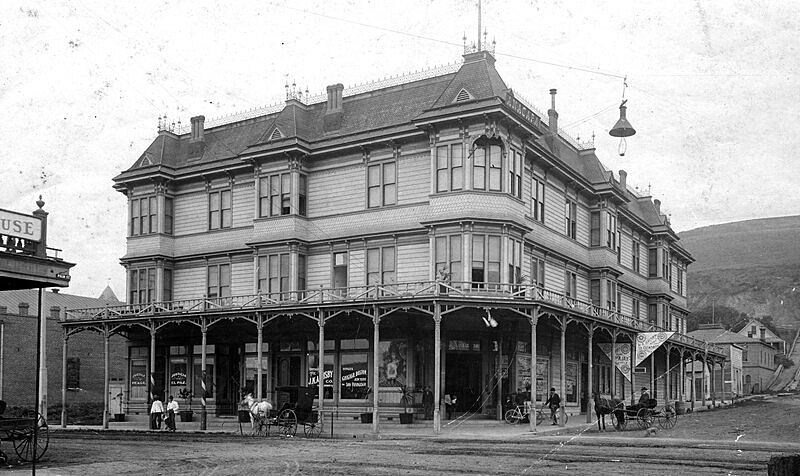
During the first night of operation, the only private building lit by electricity was the Anacapa Hotel. The popular hotel installed three arc lamps: one in the office, one in the dining room, and one in the billiard room. Curious citizens crowded in that evening to judge the illuminating power of the interior lights. Instead of praising them, hotel manager F. W. Hartman complained that the lamps gave off too much light. His reaction captured the shock of electrification. Arc lamps produced a cold, blue-white brilliance, often compared to moonlight reflecting off snow. For people accustomed to the soft, shadowed glow of kerosene, the light felt harsh and intrusive. It exposed peeling paint, dirt on the floor, and every detail of a guest’s face. Spaces that had once felt private and dimly lit suddenly seemed exposed, almost public. Hartman’s discomfort reflected the broader tension of modern technology colliding with Victorian ideas of comfort, privacy, and atmosphere. By the end of the month, The Ventura Weekly Post and Democrat reported that the number of lights in operation had grown to forty-eight. In addition to street lighting in the city and county, electric lights now appeared at Armory Hall, the Public Library, the Rose Hotel, several downtown businesses, and in the homes of nearly a dozen prominent citizens.
The Economics of Light
By September 1890, the struggle was effectively over. The Gas Company’s electric plant was silent, and Ventura’s skyline was now defined by the poles and wires of the Ventura Land and Power Company. The new system changed daily life, but not evenly. Street arc lights, paid for by the town, illuminated public spaces and were shared by everyone. Electric lighting inside homes, however, was costly. Incandescent lamps rented for about one dollar per month, a price largely affordable only to businesses and wealthy residents. That $1 monthly charge would equal roughly $35 a month today for the same level of service. Hotels and other prominent buildings were the first to adopt electric light, while working-class families continued to depend on kerosene. Electric lighting had arrived in Ventura, but it did not shine equally on all.
The Aesthetic Shift
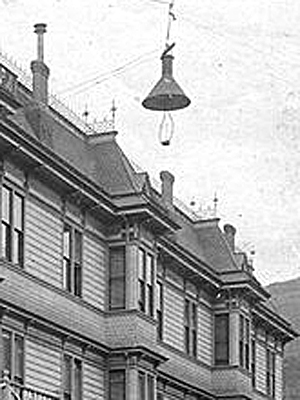
The new electric lighting transformed how Ventura looked and felt. By September 1890, the city had shifted from warm, flickering illumination to light that was steady, bright, and exposing. Streets became clearer and safer, but also less forgiving. Nightlife grew more public, and darkness lost much of its cover. The Ventura Weekly Post and Democrat captured the moment with a mix of Victorian boosterism and classical imagery: “From a Cimmerian darkness the fair city by the sea will shine at night with a brightness equal almost to that of our satellite when at its full.” In just ninety days, from June to September 1890, Ventura was transformed from a quiet, pastoral town into a city of electric light.
While arc lights conquered the streets, the struggle inside the home was far from settled. Kerosene remained inexpensive and widely used, though its light was weak. Early electric lamps in homes were often simple bulbs hanging from the ceiling, known as pendants or drop lights. A twisted, cloth-wrapped cord ran to a small porcelain rosette on the ceiling, connecting the lamp to the house wiring. Some homes installed more elaborate fixtures that resembled gas or oil lamps, with dark brass fittings and shades of frosted or milky glass. Many used Edison-style carbon filament bulbs, which were safe and cast a warm glow. In 1890 Ventura, the clean and controlled incandescent lamp was the ideal indoor light, but its high cost placed it beyond the reach of most families. For another generation, kerosene continued to light working-class homes, even as the streets outside blazed with electricity.
Consolidation Into the Future
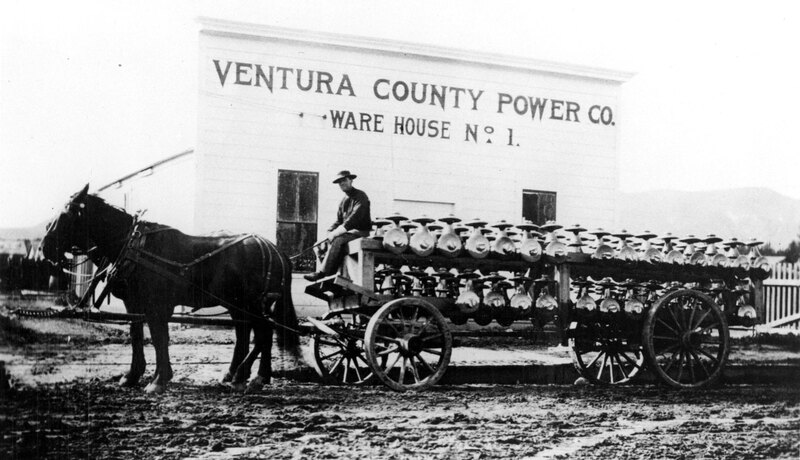
The Ventura Land and Power Company and the Ventura Gas Company did not remain local enterprises for long. Economic reality favored larger, centralized systems, and small-town utilities were gradually absorbed into regional networks. In 1901, the Ventura County Land and Power Company took over the Santa Ana Water Company, gaining control of the Rose Mill water rights that had powered Ventura’s original electric system. By 1906, the Ventura County Power Company was formed, merging the electric systems of Ventura, Oxnard, and Santa Paula and bringing the era of independent, town-based power companies to an end. In 1914, Pacific Light and Power, controlled by Henry Huntington, purchased a controlling interest. Huntington needed enormous amounts of electricity to operate his expanding Pacific Electric railway system. Just three years later, Southern California Edison acquired Pacific Light and Power. The small water wheel installed in 1890 had become the ancestor of the vast electrical grid that now powers much of Southern California.
The gas industry followed a parallel but separate course. Ventura’s gas company shifted its focus back to gas service, which remained essential for heating and cooking. It invested in new gas lines and facilities to manufacture and distribute gas. During the 1890s, Ventura’s gas system was absorbed into Pacific Lighting’s growing network. In the early 1900s, these holdings were reorganized and standardized, and by about 1911–1913 Ventura’s gas service had become part of the newly formed Southern California Gas Company. From that point on, gas service in Ventura was no longer a local business, but one link in a regional monopoly.
The events of the summer of 1890 marked the beginning of this transformation, setting the stage for the rise of the large Southern California utility companies that would shape the region’s energy landscape for decades to come.
Make History!
Support The Museum of Ventura County!
Membership
Join the Museum and you, your family, and guests will enjoy all the special benefits that make being a member of the Museum of Ventura County so worthwhile.
Support
Your donation will help support our online initiatives, keep exhibitions open and evolving, protect collections, and support education programs.
Bibliography
- “Arc Lamp.” Wikipedia, the Free Encyclopedia. Last modified November 23, 2025. https://en.wikipedia.org/wiki/Arc_lamp.
- Bodenhamer, Paul. “The Life of G.W. Chrisman in Ventura County.” Ventura County Star, November 15, 1935.
- Butterfly, Betty. “The Light Bulb: From Arc to Incandescent to Fluorescent to LED.” FindLight Blog. Last modified August 31, 2019. https://www.findlight.net/blog/the-light-bulb-from-arc-to-incandescent-to-fluorescent-to-led/.
- “Driving After Sundown: The Evolution of Headlights.” AACA Museum, Inc. Hershey, PA. Accessed January 8, 2026. https://atexpa.org/exhibit/headlights/.
- “E. P. Foster.” Wikipedia, the Free Encyclopedia. Last modified October 17, 2025. https://en.wikipedia.org/wiki/E._P._Foster.
- “Early Los Angeles Street Lights.” Water and Power Associates. Accessed January 8, 2026. https://waterandpower.org/museum/Early_Bureau_of_Power_and_Light_Streetlights.html.
- “Edison International History: Founding, Timeline, and Milestones.” Zippia. Last modified July 21, 2023. https://www.zippia.com/edison-international-careers-3741/history/#.
- “Gas Lighting.” Wikipedia, the Free Encyclopedia. Last modified December 31, 2025. https://en.wikipedia.org/wiki/Gas_lighting.
- “Gaslight, Arc Light, and Moonlight.” Robert Brighton. Accessed January 8, 2026. https://robertbrightonauthor.com/blog/lighting.
- “Historic Resources Evaluation, Avenue Water Treatment Plant, Ventura, California.” San Buenaventura Research Associates. Last modified May 14, 2002. https://www.waterworkshistory.us/CA/Ventura/2002HistoricalSetting.pdf.
- “Historic Resources Survey Update, City of Ventura, California.” Historic Resources Group. Last modified April 2007. https://californiapreservation.org/wp-content/uploads/2015/12/VenturaHRGSurveyReportFULL.pdf.
- “Our History.” Edison International. Accessed January 8, 2026. https://www.edison.com/about-us/our-history.
- “Overview: From Indigenous Stewardship to Millennial Crisis.” University of California Press. Accessed January 8, 2026. https://content.ucpress.edu/chapters/10356.ch01.pdf.
- Sheridan, E. M. “Chrisman and Wilde Proposed First Electric Light System.” Ventura County Star, May 20, 1927.
- Sheridan, E. M. “In the First Days of Electric Light.” Ventura Daily Post, March 28, 1924.
- “Skagit County Historical Museum Brings the Past to Life !” Skagit County Government. Accessed January 8, 2026. https://skagitcounty.net/Departments/HistoricalSociety/Tour/23.htm.
- “Southern California Gas Company.” Wikipedia, the Free Encyclopedia. Last modified May 25, 2025. https://en.wikipedia.org/wiki/Southern_California_Gas_Company.
- “Thomson-Houston Electric Company.” Wikipedia, the Free Encyclopedia. Last modified February 9, 2025. https://en.wikipedia.org/wiki/Thomson-Houston_Electric_Company.
- Triem, Judy. “Ventura County Cultural Heritage Survey, Phase I.” Ventura County Resource Management Agency – Ventura County Resource Management Agency. Last modified July 1981. https://rma.venturacounty.gov/wp-content/uploads/2024/03/final-report-cultural-heritage-survey-phase-1-oxnard-and-santa-paula.pdf.
- Ventura Free Press. “A Surprised Community.” July 4, 1890, 5.
- Ventura Free Press. “A Wandering Wheel.” August 9, 1890, 1.
- Ventura Free Press. “Along the Avenue.” July 24, 1890, 2.
- Ventura Free Press. “Editorial.” August 23, 1890, 2.
- Ventura Free Press. “From Tuesday’s Daily.” July 4, 1890, 5.
- Ventura Free Press. “Lighted With Electricity.” August 8, 1890, 2.
- Ventura Free Press. “Local Brevities.” June 16, 1890, 1.
- Ventura Free Press. “Local Brevities.” June 3, 1890, 1.
- Ventura Free Press. “Local Brevities.” August 6, 1890, 1.
- Ventura Free Press. “Music By the Band.” August 23, 1890, 1.
- Ventura Free Press. “No Trade to be Made.” July 25, 1890, 1.
- Ventura Free Press. “Proposed Electric Lights.” May 30, 1890, 2.
- Ventura Free Press. “The Best Lighted Street.” August 29, 1890, 2.
- Ventura Free Press. “The City Fathers.” June 17, 1890, 1.
- Ventura Free Press. “The Electric Light Question.” June 18, 1890, 2.
- Ventura Free Press. “The Electric Lights.” July 25, 1890, 2.
- Ventura Free Press. “The Supervisors Tuesday.” June 4, 1890, 1.
- Ventura Free Press. “The Supervisors.” June 6, 1890, 3.
- Ventura Free Press. “Tuesday or Wednesday.” August 5, 1890, 2.
- Ventura Free Press. “Under the Electric Lights.” August 2, 1890, 1.
- The Ventura Weekly Post and Democrat. “Excerpts From Cline’s Letter.” June 21, 1890, 3.
- The Ventura Weekly Post and Democrat. “Let There Be Light, and There Was Light.” July 5, 1890, 3.
- The Ventura Weekly Post and Democrat. “Local Brevities.” June 28, 1890, 3.
- The Ventura Weekly Post and Democrat. “Local Brevities.” July 5, 1890, 3.
- The Ventura Weekly Post and Democrat. “Local Brevities.” June 7, 1890, 3.
- The Ventura Weekly Post and Democrat. “Ordinance No. 49.” July 26, 1890, 3.
- The Ventura Weekly Post and Democrat. “A Trip to Ventura.” August 30, 1890, 1.